
Create a Dimraeth character by choosing a race, a class and the personal options that define how the hero looks and speaks. The Early Access roster is Human, Minotaur and Elf paired with Brawler, Mage or Shadow. Race and class together shape the combat kit and skill tree; Persona and appearance are separate choices.
Before confirming, focus on the actions you will use in the opening hours. Choose a racial basic kit you like, then a class direction that complements it. Do not base the decision on an assumed later class change or on a larger promotional roster that is not present in the current creator.
Dimraeth character creation choices
| Choice | What it affects | Useful question before confirming |
|---|---|---|
| Race | Basic combat kit and racial tree contribution | Which ordinary attack rhythm do you want between spells? |
| Class | Class spells and class tree contribution | Which actions and effects do you want to develop? |
| Race–class pairing | Archetype contribution | Does the combination support the interaction you intend to pursue? |
| Attributes and their training costs | Progress toward requirements and character development | What does the next useful action require? |
| Persona | Dialogue tendencies | Which response style suits the character you want to play? |
| Appearance | Available visual customisation | Can you identify and distinguish the character comfortably? |
| World selection | The world in which the hero plays | Are you starting fresh or entering an existing world? |
Not every row is the same type of commitment. Choosing a world does not establish a different class, and changing an active spell does not establish that race can be replaced. Keep those systems separate while planning the character.
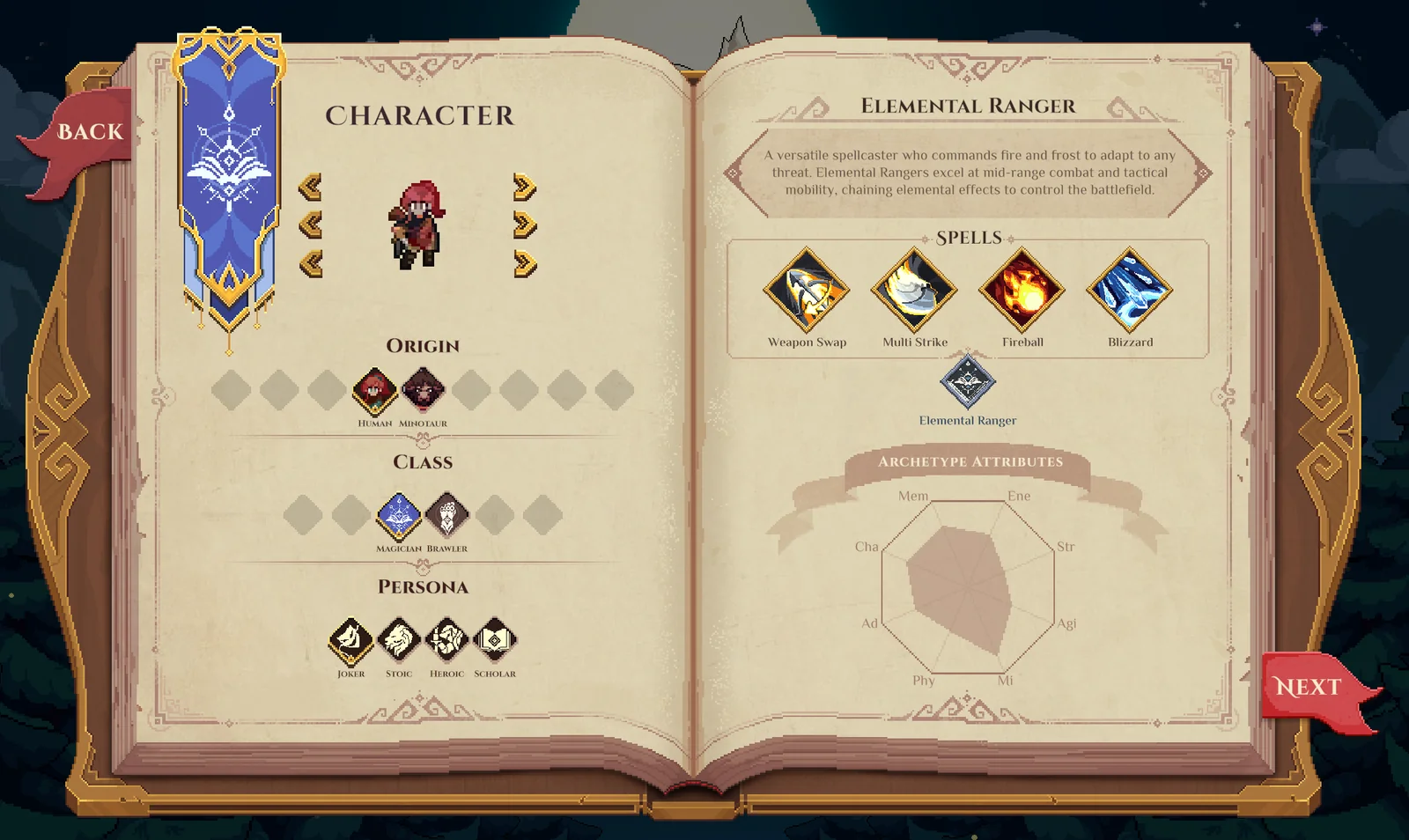
The development creator shows Human, Magician and Persona selections together. Mage and Magician refer to the same class choice; the current roster is larger than the options visible in this older interface.
Choose the race for its basic kit
Human has a sword-and-crossbow identity with Weapon Swap. Minotaur has a deliberate heavy melee rhythm. Elf is shown with dual daggers, including when the selected class is Mage. These basic actions remain relevant because ordinary attacks contribute to combat resource recovery.
Human is worth considering if you want to make decisions between close and ranged basic-attack positions. Check the current Weapon Swap tooltip for any cost before choosing a Human around frequent switching; no particular resource cost is verified here.
Minotaur is worth considering if you enjoy choosing an opening for a committed attack. Later skills can improve mobility, but the character still asks you to understand the timing of the actions you select.
Elf is worth considering if the dagger identity appeals to you alongside the class spells. Selecting Mage does not automatically replace those daggers with an entirely ranged basic kit.
Use the Dimraeth races guide for the fuller comparison. There is no verified universal best race for every player or a same-character race-change procedure in this guide.
Choose the class without losing the race context
Brawler, Mage and Shadow are available across the three races. Minotaur is not restricted to Brawler, and Human Weapon Swap is not a Shadow-only feature. A familiar fantasy role should not override the actual choices in the creator.
Brawler examples include a Minotaur Bleed direction and a separate Blunt-conversion control interaction. Mage examples include Burning sequences and other elemental or utility choices. Shadow has a Bleed example involving positioning and follow-up actions.
Those examples help you identify a direction; they do not supply every combination's final allocation. Check the first actions you can actually use before choosing only for a distant keystone or an equipment set you have not obtained.
The Dimraeth classes guide explains the class roster. If you are undecided, hold the race constant while comparing class options. That makes it easier to recognise what the class changes.
The pairing creates an archetype layer
Race and class contribute separate parts of the visible tree, and their pairing adds the archetype contribution. This is why a class-only description cannot tell you everything about the resulting character.
A Human Mage and an Elf Mage can share a spell name while having different basic attacks and surrounding support. Conversely, Human Brawler and Human Shadow retain a common racial kit while their class and combination choices differ.
When planning, name the whole pairing. “Human Mage built around Burning” is more useful than simply “caster,” because it identifies both the recovery kit and the intended effect direction. It still leaves room to decide the actual modifiers and utility actions later.
The race, class and archetype tree guide explains how to inspect those layers and their prerequisites. You do not need to solve the entire tree before creating a character, but you should understand which combination you are choosing.
Attribute costs and the first training decisions
Race and class affect attribute-training costs in the documented character system. That makes requirements part of character planning. A direction that needs attributes outside your intended investment may demand a different training route from the one you first imagined.
Earned experience and trained attributes are not the same thing. In the demonstrated progression, experience is spent through training, attributes increase and character-level progression follows. Do not assume that merely earning experience has already raised the attribute a book requires.
Read the current cost before spending. There is no complete current price matrix for every pairing in this guide, so no race is declared numerically cheapest for every purpose. The useful comparison is the cost of reaching the requirements of an action you actually intend to use.
A cheap attribute is not automatically the best purchase. If it does not help the current character, repeatedly buying it can postpone the spell or survival improvement you wanted. Start with the next concrete goal and work backward to its requirements.
Spellbook requirements can involve several attributes
World spellbooks can broaden a character's actions, but their requirements remain individual. Meeting one named attribute does not satisfy the others. A Brawler may be able to learn a book while still needing deliberate training to use it.
Flaming Strike provides a pre-release example with Memory and Adventure requirements. The exact values should be checked in the installed version. The lesson for creation is that a spell's theme does not tell you every attribute it will ask for.
Before planning around a book, decide whether it will earn a place in the active loadout. A useful utility action may justify training outside the main direction; a spell you will never equip may not. The Dimraeth spell-equipping guide covers the learning and assignment stages.
Persona shapes dialogue choices
Persona belongs to the dialogue side of the character. The material includes different response tendencies associated with choices such as Scholar and Joker. Treat those as ways the hero can speak, rather than a substitute for race or class.
Choose a style you want to read and use in conversations. Do not pick a Persona solely because an unsupported guide promises a fixed combat bonus, guaranteed romance or universally correct answer. Those claims are not established here.
Dialogue options still have context. A witty response, a personal question and a quest-related answer can lead the conversation in different directions. Read the line and the person being addressed rather than choosing only by its icon.
The long-term ability to change Persona is not verified here. Select it deliberately without assuming either a free mid-game replacement or permanent lock beyond what the interface actually tells you.
Appearance and identifying the character
The available customisation includes colours and gender options. Use the actual creator to inspect what can be adjusted on the selected character rather than assuming every race has an identical set of visual controls.
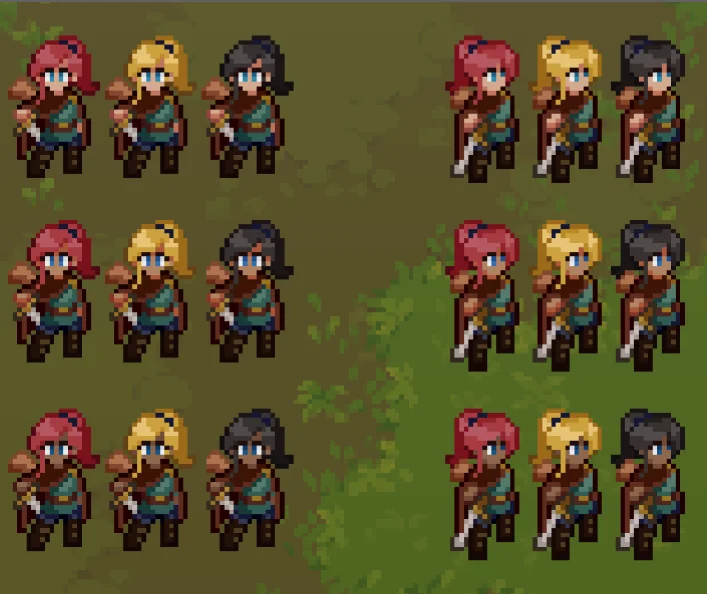
Human sprites with different hair, skin and clothing colours illustrate the appearance system. They are visual examples, not separate combat classes.
In a co-op group, distinct colours can help you recognise your own character when several players occupy the same area. This is a practical preference, not a statistic or a mechanical advantage assigned to a colour.
Review the character in the preview before confirming. Appearance decisions should be separate from the combat choice: liking a silhouette is valid, but it does not establish the fastest attack speed or a hidden resistance bonus.
The current procedures for later renaming or replacing every appearance choice are not established here. Avoid treating unverified later editing as part of the creation plan. Choose an appearance you are comfortable keeping while you begin the game.
Character selection and world selection
A character and a world are different objects in the progression system. The recorded material shows a newly created character entering an existing world. That should not be confused with changing the race or class of the character already used there.
Your hero's level, equipment, inventory, spells and personal progression travel with the hero. Story progress, recruited allies and buildings remain associated with each world. An established base can therefore offer a different environment from a fresh world without turning the new character into a copy of another hero.
For a first playthrough, know which world contains the story and services you want to develop. For co-op, agree which world you are continuing together. This avoids interpreting missing NPC services in another world as a class or character-creation problem.
Relationships also need their world context. A conversation or relationship state in one world should not automatically be treated as the same ongoing state in another. Keep the character, world and NPC identity clear when checking progress.
Prepare the first spell loadout
Dimraeth supports five equipped spells. The tree and world books can add more choices over time, but the active bar still asks you to choose a set of actions that work together.
Start with the spells actually available. Identify what each one does, how it is activated and what it costs. A held charge should be practised as a held charge, not judged only by a quick tap that produces a different result.
Basic attacks that hit restore Concentration during combat. Include that recovery rhythm when imagining the character's playstyle. A Mage is not exempt from it, and a physical-looking active skill is not automatically the same thing as an ordinary recovery attack.
If the opening loadout feels awkward, inspect input and assignment before deciding the creation choice was a mistake. A missing slot, a rebound button or an unmet requirement can make the character appear less capable than its actual kit.
Find the training interaction after earning experience
The early playthrough material includes training through a campfire interaction and through a trainer. When you return with experience, inspect that interaction rather than assuming the character sheet has already applied an attribute increase.
Read the attribute and price selected before confirming. Afterward, check the resulting attribute, character-level progress and available skill points separately. These displays answer different questions: whether a book requirement is met, whether the level advanced and whether a tree purchase is now available.
If the goal was to learn one specific book, return to that book and compare all its requirements again. Spending experience on a different attribute may still advance the character without solving the original requirement. This small check prevents a first training session from becoming an unexplained loop of more combat and the same unusable item.
A short first-encounter test
Before judging the creation choice, check that you can land the racial basic attacks and activate the starting spells as intended. Use the Dimraeth movement guide to investigate positioning or recovery problems. If an action is missing from the bar, follow the spell assignment steps before creating another character.
Creation choices and later resets
Attribute refunds, skill respec, active spell changes and class changes are different operations. Evidence that one reset exists does not prove that every creation decision can be undone through it.
The current complete skill-reset procedure and price are not verified here, and a same-character class-change procedure is also unresolved. Do not create a character on the promise that a particular merchant will later replace its class unless the actual service establishes that behaviour.
You can still make an informed first choice without knowing every later option. Select a race whose basic kit appeals to you, a class with actions you want to develop, a Persona you want to use and an appearance you can recognise. Enter the intended world, learn the opening rhythm and make the next investment for a specific purpose.
That approach leaves room to discover books, modifiers and equipment without pretending those future discoveries were all determined at the creation screen. The creator defines the starting identity; the decisions you make with the available tree and loadout develop how that identity plays.
Before committing to a character, check the limits of Dimraeth class changes and Dimraeth skill-point respec. The Dimraeth romance guide explains relationship scope, while the Dimraeth Early Access max-level guide separates the character cap from other progression numbers.