
The verified way into Dimraeth Deeds is the Deed Board after sufficient story progression, but the available documentation does not establish one exact quest name or boss as a universal unlock trigger. Keep the main campaign moving, return to the board in the guild-hall progression loop, and look for a selectable Deed rather than treating a board objective or ordinary bounty as proof that the repeatable boss system is already open. Once Deeds are available, start at a tier your character clears reliably and move up only when the reward target and difficulty justify it.
That boundary matters. Third-party summaries suggest a more precise trigger, but a summary is not enough to establish a quest requirement as fact. Documented gameplay confirms the functional pieces: Deeds are repeatable content, they let players challenge bosses again, difficulty increases, the Deed Board is the access point in the recorded Early Access run, and rewards can include progression, materials, equipment, and boss-specific reasons to repeat a fight. This page explains how to reach and verify that state without inventing a missing unlock objective.
Dimraeth Deed unlock checklist
Use this checklist as a state diagnosis, not as a claim that every line is a hidden prerequisite.
- Continue the main storyline rather than spending all available time on side jobs or Sanctum decoration.
- Revisit the guild-hall board as major story stages are completed.
- Separate ordinary board tasks, Bounties, and selectable Deeds by reading the activity name and reward panel.
- Confirm that a Deed can be selected and entered before planning a boss farm.
- Begin with the lowest available level that your current character can clear without consuming disproportionate healing or time.
- Inspect the reward interface after the clear and spend useful materials or progression before immediately repeating the same tier.
If the board contains quests but no Deed, the useful next action is campaign progress. The current available documentation does not support crafting a Deed item, finding a secret Deed NPC, or killing random enemies until the option appears. Do not turn those guesses into a grind.
The Dimraeth walkthrough keeps the campaign spine separate from repeatable activities. Follow that route when the board is not yet offering the system. If story progression is clear but combat is stopping you before the next milestone, use the Dimraeth build overview to identify whether damage, survival, equipment synergy, or spell access is the actual bottleneck.
Deed Board state and activity types
The Deed Board is important because it turns a one-time encounter into repeatable content. A story boss disappearing from its original arena does not prove the associated fight is gone forever; the board provides the replay structure after it becomes available.
The available material also uses “Bounties” alongside Deeds. Reward presentation can differ from one activity to another, so read the selected entry rather than assuming every board item follows the same rules. A job that asks for gathered supplies, a bounty, and a tiered boss rematch may all occupy the wider board loop without being interchangeable.
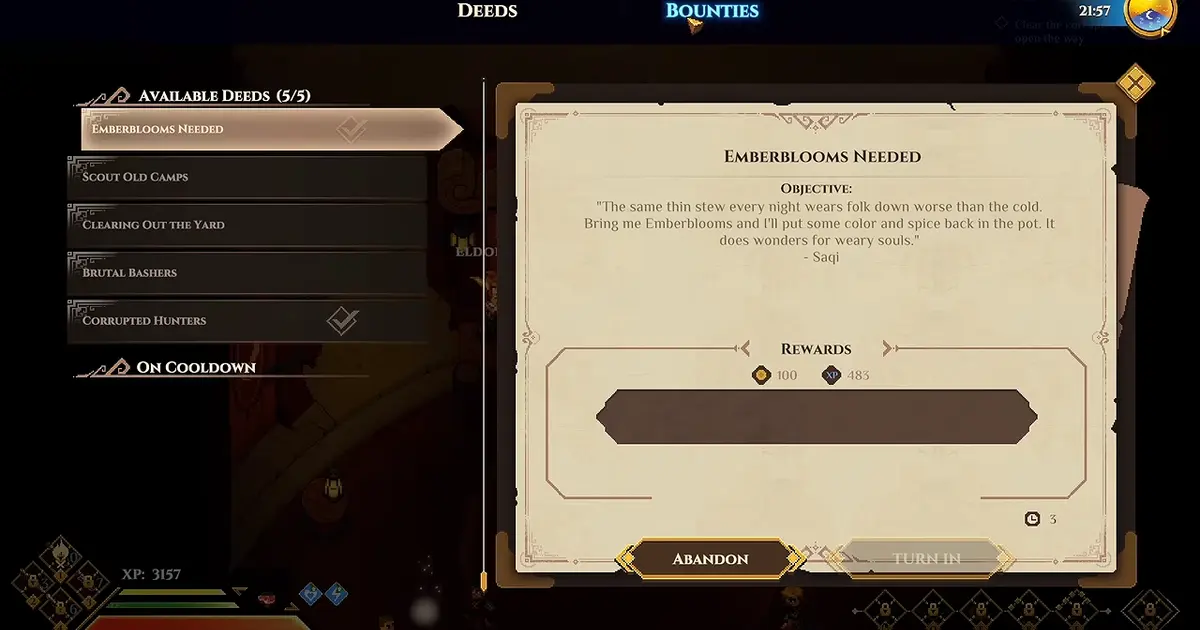
The Deeds tab separates available activities and their reward panels from other board work.
Before entering, record what the selected activity is supposed to accomplish. A Deed can be worth running for a boss component, a piece of equipment, character progression, or simply a controlled test of a build. If you cannot name the target, raising the tier adds risk without giving you a way to judge success.
The documented gameplay shows levels 1 through 10 on its board. That is a documented player-facing range in the source, not a promise that every Deed, patch, or future act will always expose exactly the same range. Read the board in your installed Early Access version as the final authority.
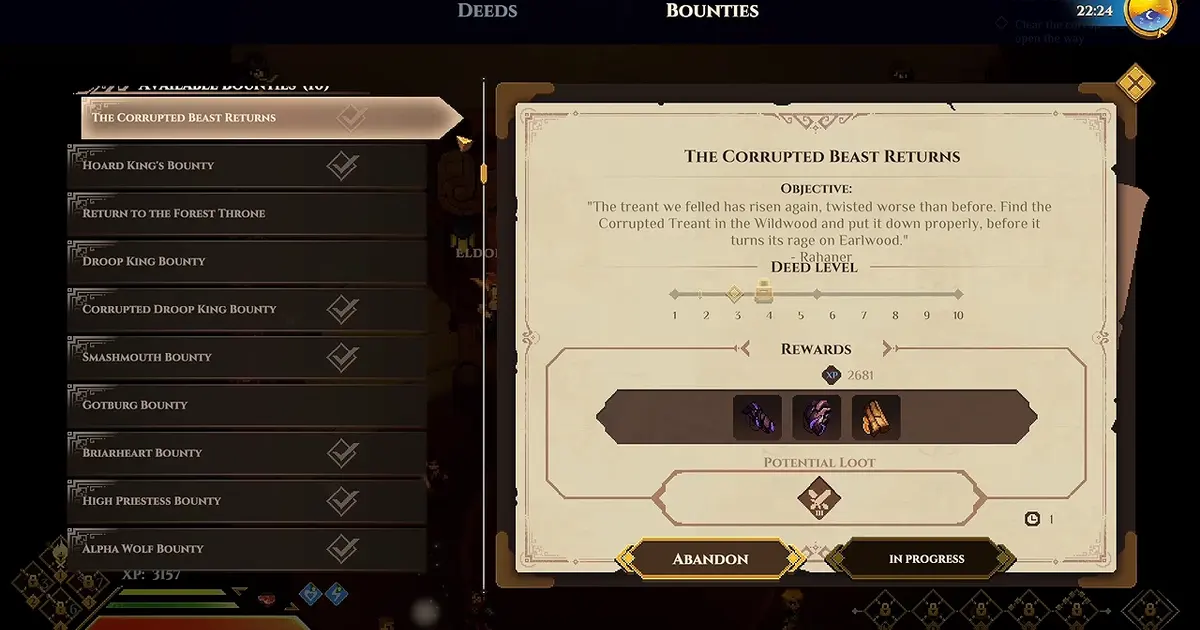
This recorded board state shows a level selector and Potential Loot together; use the values displayed by the current build.
Progression evidence and the missing exact trigger
Several pieces of evidence agree that Deeds sit after meaningful progression and support late-game repeat activity. A community developer reply describes repeatable late-game content and unique-set boss challenges that get progressively harder. A separate documented gameplay demonstrates the Deed Board and tiered runs. Community footage also records Deed levels well above the first tier.
No trustworthy step-by-step unlock transaction is currently documented. None of the available video segments shows the board changing from locked to unlocked. The most precise trigger appears only in a third-party snippet, which is not enough to establish it as a game fact.
The practical consequence is simple: this guide can tell you how to recognize access and what to do when it is absent, but it cannot responsibly say “complete quest X and the board unlocks immediately.” If your board state differs, that is an evidence gap rather than proof that your save is broken.
When diagnosing, note the last main-story objective completed, the exact board entries visible, and whether the board offers a turn-in control for an outstanding task. Some recorded board jobs require an explicit turn-in action before more work appears. That does not prove the same action unlocks Deeds, but it makes an unfinished board transaction worth checking before assuming progression failed.
Choosing a first Deed level
Start where the fight is controlled. The source guide recommends a level that can be cleared cleanly, then increasing difficulty after using the rewards. A higher number is not automatically more efficient if every attempt consumes the resources needed for the next run.
Use three signals:
| Signal | Ready to continue | Ready to move up | Ready to step down |
|---|---|---|---|
| Survival | Mistakes are recoverable | Most attacks are understood and healing remains | One mistake causes a death or the route drains supplies |
| Clear pace | The approach and boss remain consistent | Damage has improved enough to shorten the repeat | Ordinary enemies or the boss turn the run into attrition |
| Reward goal | The run advances a named material or build need | Current tier no longer challenges the upgraded build | No useful return offsets the cost of repeated failures |
This is not a fixed level recommendation. Character race, class, spell access, equipment sets, and player comfort all change the answer. A solo character and a coordinated group can also experience the same encounter differently. The board and the fight provide better evidence than a universal “best tier.”
A community Corrupted Beast report describes a level-32 character still struggling above Deed level 8 while finding the preceding monsters comparatively easy. That is one player's balance observation, not a requirement or scaling formula. It does, however, illustrate why the boss result matters more than how effortless the approach feels.
Deed rewards and a useful farming target
Equipment is only one reason to repeat a Deed. the available documentation records a boss clear awarding a skill point, continued experience, boss materials that can serve spellbook or upgrade goals, and different reward presentations between activities. A harder kill also produced a purple item in that run.
Do not convert those examples into guaranteed drops. The source explicitly stops short of proving a guaranteed purple threshold, and a single skill-point result does not establish that every Deed or tier awards one. Inspect the reward preview and the result screen for the activity you are actually running.
A useful farming target has three parts:
- a named outcome, such as a component shown by a spellbook recipe or a set piece relevant to the build;
- an affordable tier, where failed attempts do not consume the entire preparation stock;
- a stopping rule, such as leaving to craft, upgrade, or test after the needed component drops.
That stopping rule prevents rewards from sitting unused. If a boss material completes a book, return to the relevant service and make the book. If equipment changes a set bonus, compare the active set before dismantling the old piece. If the clear grants progression, spend it before judging the next tier.
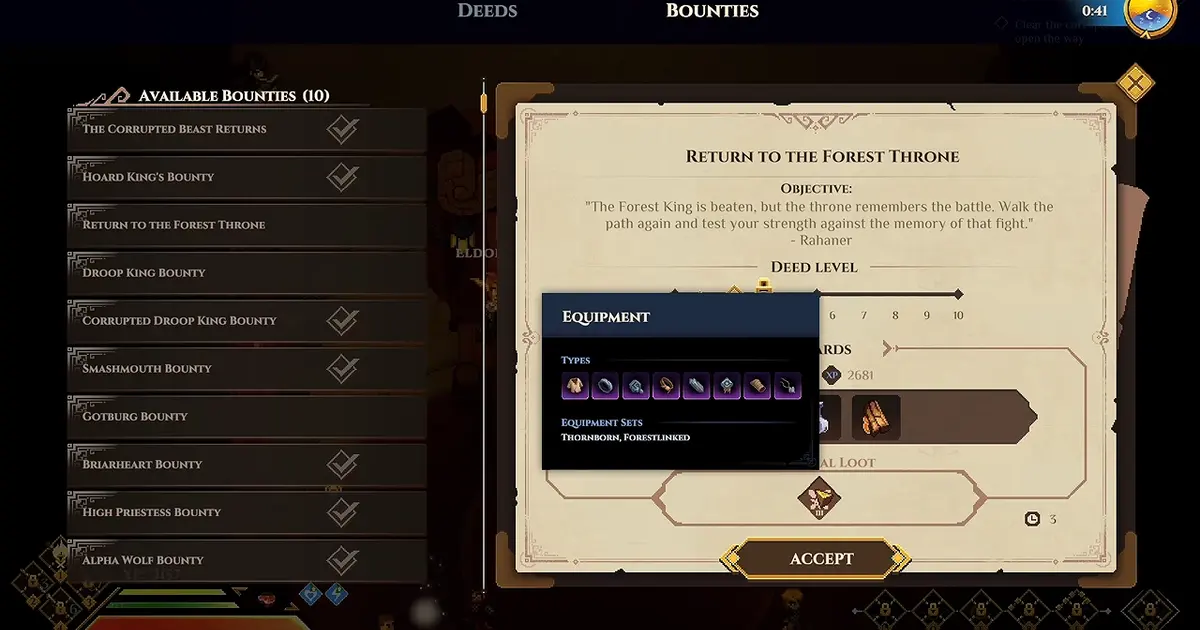
Inspect the selected reward tooltip for item and set information before choosing a repeat target.
The Dimraeth spellbook locations guide distinguishes a recipe or material lead from a crafted, learnable book. That distinction is important in Deed farming: obtaining a boss component may solve only one stage of the acquisition chain.
Build preparation before a harder tier
When a Deed becomes unreliable, identify the failure instead of raising the number again. The supported preparation categories are equipment, spell and skill access, upgrades, consumables, and player execution.
Start with the death pattern. If one telegraph repeatedly ends the run, learn its timing and position before changing the entire build. If ordinary enemies consume the supplies needed for the boss, improve the approach or step down. If the boss survives comfortably while the character runs out of damage resources, inspect spell synergy and set effects.
Set equipment deserves special care. Player material reports unique sets as a reason to repeat bosses, while other documented gameplays show that mixed set bonuses can define a build. A higher-rarity individual item is not automatically an upgrade if equipping it removes the effect that makes the build function. Compare the full result after the swap.
Use the Sanctum between attempts. Crafting a needed book, improving a potion chain, reinforcing an item, or changing prepared food can make the next test meaningful. The purpose is not to build every facility before returning; it is to remove the specific bottleneck exposed by the last fight.
Co-op is another supported option when a tier outgrows the current solo setup. The evidence confirms Dimraeth as a multiplayer RPG and describes Deeds as progressively harder, but it does not provide a fixed party-size formula for each tier. Bring other players when collaboration solves the actual encounter rather than assuming the tier was balanced for a specific number.
Deed access troubleshooting
Board visible without selectable Deeds
Continue the main campaign and revisit the board after substantial progression. Check for a completed board task that still needs an explicit turn-in. Do not farm random world encounters expecting a hidden counter; no such counter is established in the evidence.
Boss absent from its story location
Do not wait at an empty story arena for an assumed respawn. The repeat structure is tied to Deeds and the board. If Deeds are not available, return to progression rather than repeatedly resting beside the old arena.
Deed available but entry fails
Read the selected activity state, tier, and any visible requirement. Not every entry restriction is currently documented, so preserve the exact interface text instead of guessing that character level, time, or another material is required.
Rewards differ from another guide
Compare activity type, tier, game version, and the actual reward panel. A higher-tier purple result is possible in the recorded material, but no guaranteed threshold is proven. A different result does not by itself indicate a bug.
Next tier feels disproportionately hard
Step back to a controlled tier, spend the rewards already earned, and identify whether the route or the boss is causing the resource loss. Community feedback shows that approach enemies and a boss can feel uneven within the same Deed.
Completed Deed did not solve the build goal
Verify what dropped and what the intended craft or set actually requires. “Boss material” is a category, not proof that the specific component needed appeared. Leave the loop when a useful result is available and apply it before running again.
Efficient repeat loop
A disciplined Deed loop is shorter than an aimless one:
- Read the board entry and choose a named reward purpose.
- Select a level that is currently reliable.
- Prepare the spells, equipment, consumables, and group needed for that encounter.
- Clear the approach without wasting the resources reserved for the boss.
- Read the actual reward result.
- Return to craft, equip, reinforce, learn, or spend anything that advances the character.
- Test the changed build at the same level before raising the tier.
The last step matters because it gives you a comparison. If the same encounter becomes cleaner after an upgrade, you have evidence that the character is ready to test more difficulty. If the result barely changes, raising the tier may only magnify the unresolved problem.
Deeds should support progression rather than replace the entire game. Side quests, recruited services, Sanctum production, spellbooks, pets, and story access can all provide a better next improvement than another identical clear. The Dimraeth pet guide covers a separate unlock chain where progression, an encounter, an NPC service, acquisition, and equipment are distinct stages.
Verified scope for Early Access
This page is intentionally marked partially verified. The evidence supports the Deed Board, repeatable boss content, rising difficulty, a player-facing 1–10 range in the documented gameplay, varied rewards, and the use of Deeds to pursue progression, materials, and equipment. It also supports the practical advice to start at a manageable tier and spend the results before climbing.
The evidence does not support one universal quest trigger, guaranteed reward tables, a fixed rarity threshold, exact drop rates, or a character-level rule for each tier. Those gaps remain open rather than being replaced by details copied from titles or search snippets.
If your only problem is that the board does not yet expose a selectable Deed, keep the main story moving and record the exact board state. If Deeds are already open, stop thinking of the task as an unlock problem. It is now a preparation and reward-target problem, and the board gives you the information needed to choose the next repeat responsibly.