
Plan frost attributes around the ice ability you can actually learn and use. Intelligence contributes to Magic Damage, while a race/class passive can make another attribute relevant. Learning requirements and the resources spent on each cast are separate fields. No verified optimal Ice Mage allocation or level-by-level stat table is established here.
The examples separate a Minotaur Magician's Blizzard modifier from Frozen Strike on a recorded Elf Shadow. One changes the behavior of a frost spell; the other shows learning requirements for a hybrid attack. Neither is a complete optimal Magician allocation. For a full Elf Mage progression framework, use the Elf Mage guide.
Distinguish Blizzard from Frozen Strike
Blizzard is part of the documented Magician frost kit. It produces an icy storm, applies Chill and leaves an Ice Pool. Frozen Strike is a separate learned skill that splits its damage between Thrust and Ice. A character using Frozen Strike is therefore not automatically dealing only magical ice damage.
Choose the ability first. An attribute that benefits Magic Damage does not, by itself, describe every part of a hybrid attack. Likewise, seeing Chill in the effect text does not reveal the skill's learning threshold, resource cost or damage scaling.
The current Blizzard learning requirements and an optimal Blizzard allocation are not confirmed in this material. Do not substitute Frozen Strike's numbers for Blizzard simply because both involve ice.
Read the recorded Frozen Strike requirements
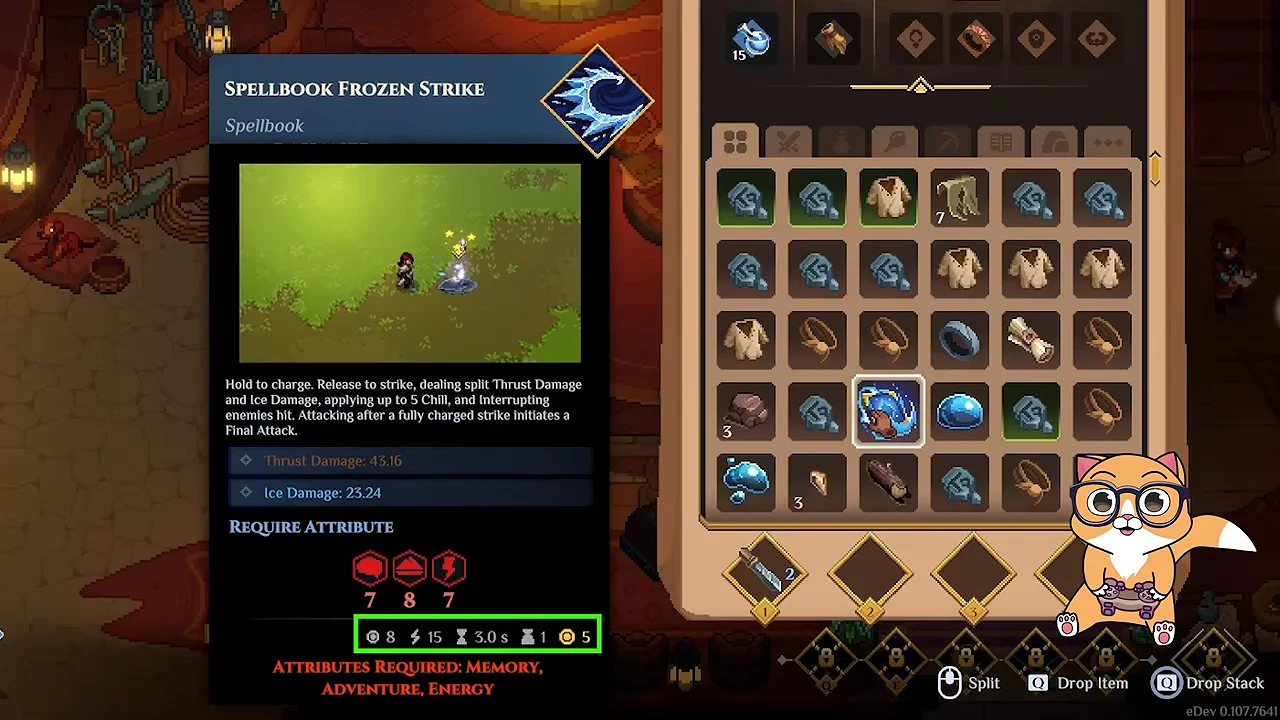
eDev 0.107.7641: Frozen Strike separates learning requirements from casting costs. Values belong to this recorded character and build.
The eDev 0.107.7641 tooltip gives a concrete example of the fields to separate:
| Field | Recorded Frozen Strike value | Meaning for attribute planning |
|---|---|---|
| Memory requirement | 7 | Learning threshold for this displayed version |
| Adventure requirement | 8 | A separate learning threshold |
| Energy requirement | 7 | A separate learning threshold |
| Concentration cost | 8 | Resource spent using the skill |
| Stamina cost | 15 | Additional resource cost for this hybrid action |
| Cooldown | 3 seconds | A timing condition, separate from attributes |
| Damage types | Thrust and Ice | The attack contains two damage components |
These are recorded tooltip values, not an optimal endgame stat sheet or a promise that every later version uses the same requirements. Compare your current tooltip before training. The Memory, Adventure and Energy thresholds explain why an Agility-focused Elf Shadow might still need other attributes to learn this particular skill; they do not establish how every Ice Mage should distribute all remaining points.
Check the learning fields first, then check whether your current resources cover the cast. Meeting a threshold does not prove that repeated casts are sustainable. If Stamina is the limiting resource, improving Concentration alone will not remove that restriction.
Account for the exact Magician archetype
A class label does not make every racial pairing scale identically. The Human Magician panel shows Adventure contributing to Magic Damage, while the Minotaur Magician panel shows a Strength interaction. Read the passive on your own pairing before comparing those attributes with Intelligence.
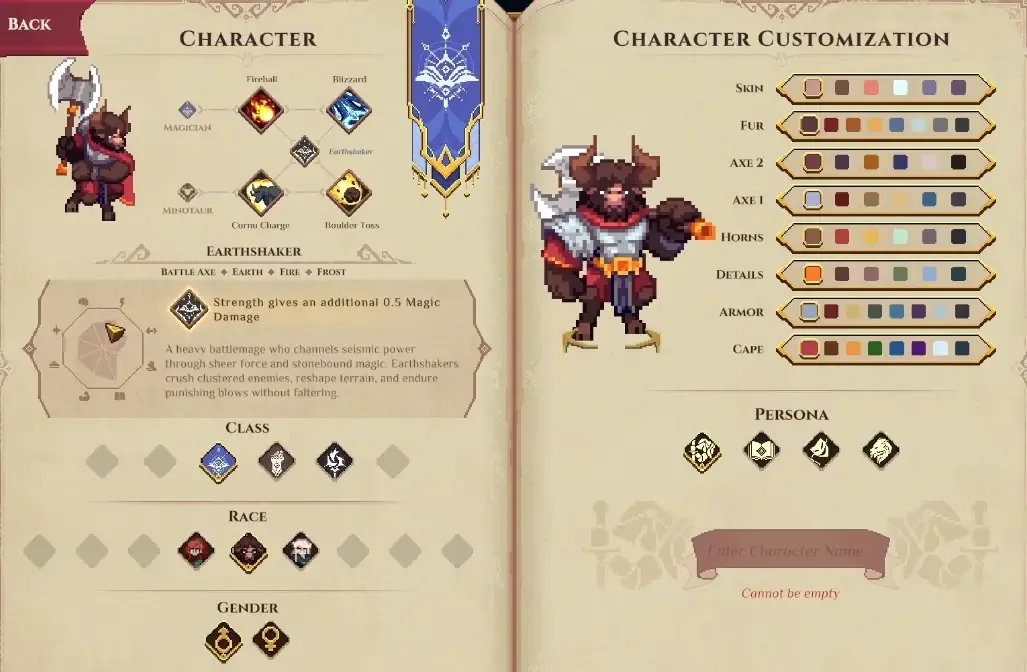
This Earthshaker panel shows its Strength interaction with Magic Damage; it is not a universal frost allocation.
This is a reason to evaluate the exact character, not a universal instruction to put every frost point into Adventure or Strength. A race-specific passive can make an attribute useful without proving that it gives the best return at every point of progression.
Physique is a health lever when survival interrupts the sequence. Treat that as a separate problem from the ability's damage component or learning threshold. A numerical allocation needs the actual chosen spells and character state; this page does not invent one.
Separate Blizzard modifiers from attribute gains
A recorded Minotaur Magician uses Centered Blizzard with Frost Glide. The creator's character invests in Strength and Intelligence and is not yet at the level cap. That is an observed frost direction, rather than evidence that every Ice Mage should copy a finished attribute sheet.
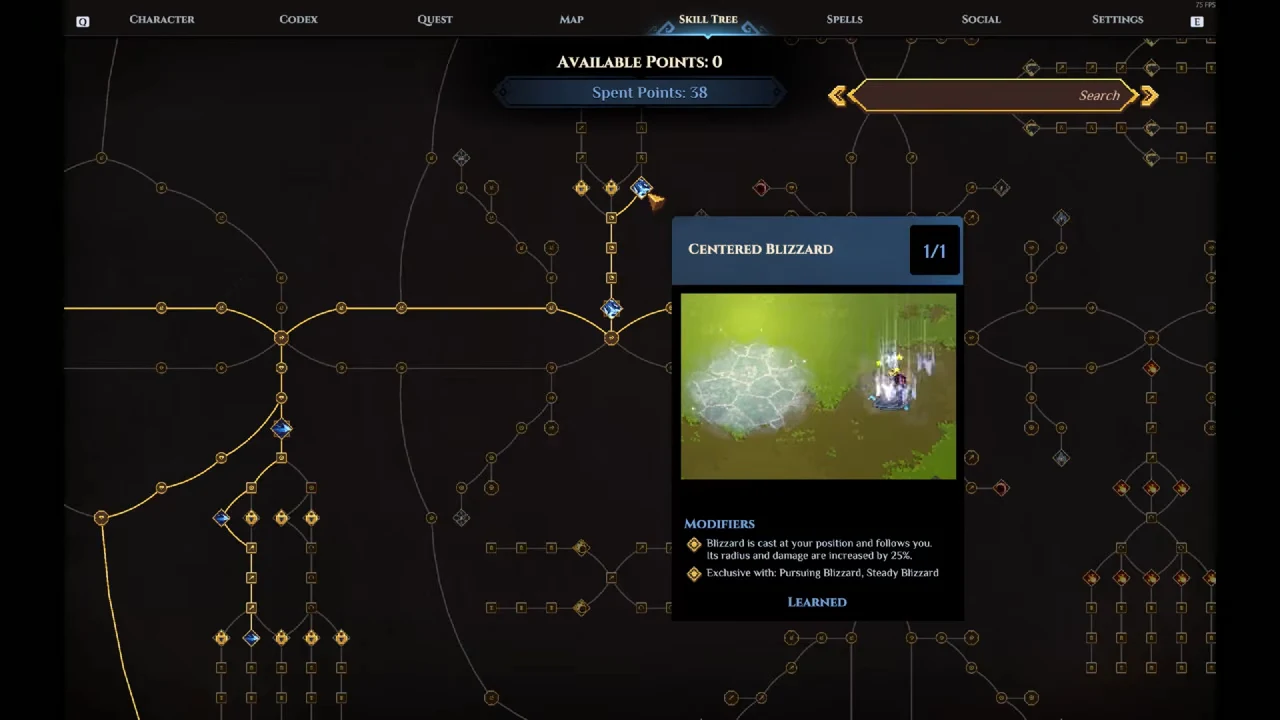
Recorded Centered Blizzard modifier: these are spell effects, not an attribute-training formula.
The Centered Blizzard tooltip describes changes to the spell itself:
| Displayed modifier field | Recorded behavior |
|---|---|
| Cast position | Blizzard is cast at your position |
| Movement | The Blizzard follows you |
| Radius | Increased by 25% |
| Damage | Increased by 25% |
| Exclusive choices | Pursuing Blizzard and Steady Blizzard |
These are the modifier's displayed effects in the recording. They do not describe what one point of Intelligence, Strength or another attribute adds. Keep a spell modifier and an attribute-training return separate when comparing your frost options. The two percentage fields also do not establish your final damage against a particular enemy.
The follow behavior explains the demonstrated pairing with Frost Glide: the character moves while the Blizzard accompanies that movement. That changes where the storm operates. It does not demonstrate a universal freeze threshold, an immunity window or a guaranteed safe route through a boss attack.
The exclusivity line matters before choosing a branch. This recorded Centered option cannot be treated as a bonus that automatically stacks with Pursuing and Steady Blizzard. Their names appear in the exclusion line, but this image does not establish their full effects. Read the alternative tooltips available to your own character before replacing a modifier.
For stat planning, separate the tasks: meet the chosen spell's learning requirements, inspect your exact archetype's attribute contribution, and then consider a modifier that changes the frost action you want. Centered Blizzard provides a concrete behavior choice; it does not fill the missing Blizzard requirement table or supply a best per-level allocation.
Choose whether Blizzard applies or consumes Chill
Blizzard's damage and its Chill application are separate parts of the frost plan. A modifier can change the job of the same named spell, so deciding to use Blizzard is not yet enough information to choose every damage attribute.
| Named Blizzard option | Effect to check on your character | Planning consequence |
|---|---|---|
| Icy Fortification | Allies inside Blizzard gain 30% Armor and Resistance | The storm can have a defensive job as well as a damage job |
| Soft Blizzard | No damage, twice the Chill application and a 50% larger area | Its purpose is setting up Chill rather than producing Blizzard damage |
| Frost Bite Blizzard | Consumes Chill for 10% additional damage per consumed stack | Its damage condition depends on an existing Chill setup |
Soft Blizzard and Frost Bite Blizzard are mutually exclusive choices. Do not plan a single cast that both preserves Soft's no-damage setup behavior and gains Frost Bite's consumption payoff. These effect descriptions also do not establish which nodes your specific archetype can reach. Use only a modifier actually available on your character, with the same conditions in its current tooltip.
Soft Blizzard gives a concrete reason to avoid treating Magic Damage as the only decision. Increasing a damage statistic is not a substitute for checking whether the chosen Blizzard modifier deals damage at all. Your other equipped spells can still have damage requirements; the choice concerns this action's job, rather than a claim that a support character should never train a damage attribute.
For Frost Bite, check which action creates the Chill that the cast will consume. A per-stack bonus describes a condition, not a guaranteed total damage number. No verified stack cap, enemy-specific damage result or complete attribute formula is established here. Keep that consumption choice separate from a modifier that uses the storm to supply protection or more Chill.
Separate Frost Glide movement from frost payoffs
Frost Glide combines movement with Ice damage and Chill along its path, leaving Ice Pools. The described two-second dash is a movement duration, not a cooldown or a statement that another cast becomes available after two seconds. This distinction matters when deciding whether your character has the resources and the actual recharge behavior needed for the sequence.
| Frost Glide modifier | Described effect |
|---|---|
| Frost Armor | Hitting enemies during the glide grants Frost Armor stacks |
| Cryo Surge | An ending surge damages and Chills nearby enemies |
| Shattering Step | Consumes Chill on enemies for 50% more damage |
These choices give the action different jobs. Frost Armor ties protection to hits; Cryo Surge adds an effect around the ending position; Shattering Step uses a Chill setup for damage. None of those descriptions supplies a complete learning threshold, Concentration cost, Stamina cost or amount of protection per stack.
If you choose a Chill-consuming option, account for how the target becomes Chilled before the payoff. If you want an ending-position effect, compare that behavior with how you use the glide. Those are frost-specific decisions about the spell being trained, rather than reasons to copy a different character's entire attribute sheet.
Check Frost Javelin before choosing a Chill payoff
Frost Javelin deals Ice damage and consumes all Chill on its target. The consumed stacks add Stun build-up. That gives it a distinct payoff role alongside a storm or movement action that applies Chill; it does not prove that every hit immediately stuns every enemy.
| Frost Javelin modifier | Effect described for the impact or consumed Chill |
|---|---|
| Frost Ward | Uses consumed Chill to grant Frost Armor, increasing Armor and Resistance |
| Shatter | Creates cone damage behind the struck target |
| Icy Shockwave | Damages nearby enemies with an impact shockwave |
Choose the payoff you need before comparing damage attributes. A protective conversion, damage behind the target and damage around the impact are different outcomes. An attribute table cannot tell you which of those outcomes the selected modifier produces. Verify the exact option, then train the requirements for the action you intend to use.
Gust supplies another distinct control action: forward knockback that can interrupt small enemies' attacks. That small-enemy condition does not establish a boss interruption rule. It is also separate from Frost Javelin's Stun build-up and should not be used to invent a universal freeze or stun threshold for an Ice Mage.
Keep the frost tree tied to the chosen character
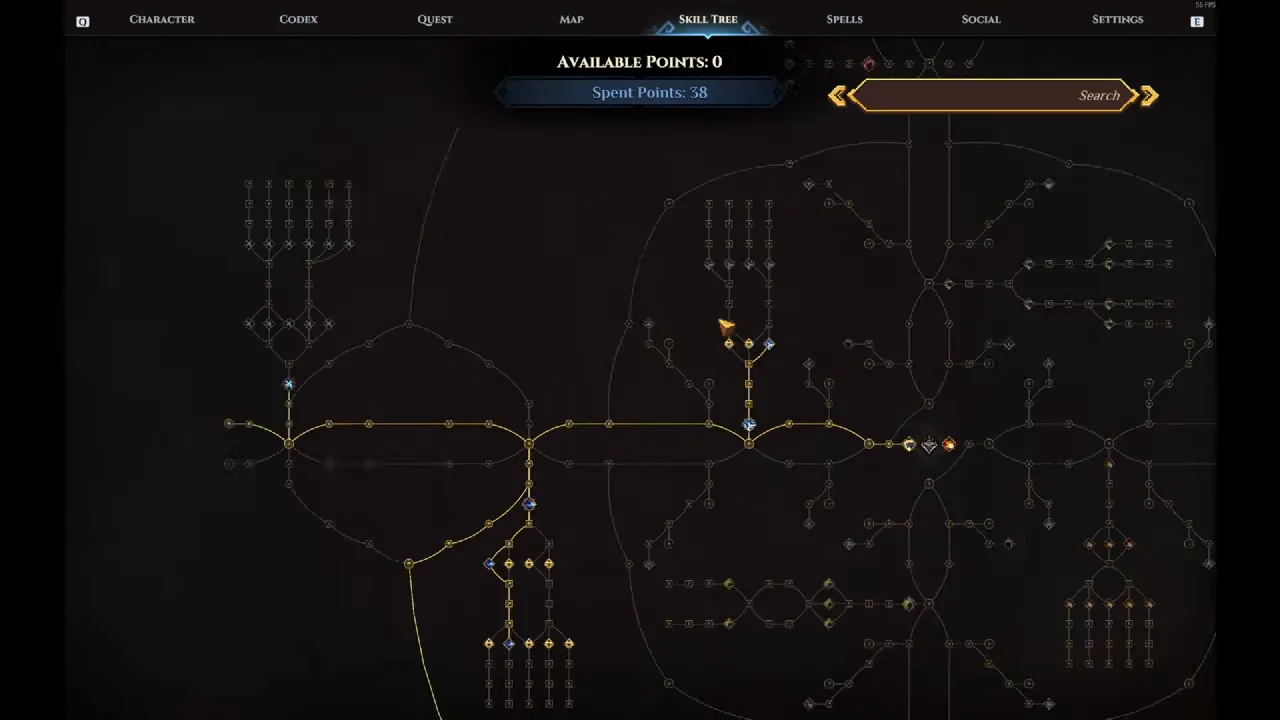
A recorded Minotaur Magician tree. Follow the nodes available to your own race and class.
The recorded Minotaur Magician tree illustrates connected frost branches. It is not a node map for an Elf Magician or an Elf Shadow. Select modifiers available to your own pairing and read whether they change the frost ability you intend to use.
For the tree's general connection rules, use the archetype skill-tree guide. For sustained casting and basic-hit recovery, use Concentration recovery. Those broader systems remain separate from the frost-specific requirements and hybrid damage example here.
The supported priority is to meet the chosen ice skill's displayed requirements, account for its actual costs, and compare damage attributes with the exact archetype passive. A claimed best Ice Mage spread, freeze threshold or boss-proof frost rotation would need additional evidence.