
Dimraeth has three Early Access classes: Brawler, Mage and Shadow. Pair any one with Human, Minotaur or Elf to create one of nine race–class combinations. Mage is also called Magician in earlier interfaces; the two names do not describe a fourth class.
Choose the class for the actions and interactions you want to develop, while choosing the race for the basic kit you want to use between those actions. A Human Mage and an Elf Mage can share class spells but still have different weapon rhythms and archetype support.
Dimraeth Early Access class roster
| Class | Concrete direction in the available material | Decision to examine |
|---|---|---|
| Brawler | Minotaur Bleed, plus a separate Blunt-conversion control interaction | Attack commitment, resource generation and the movement retained by the loadout |
| Mage / Magician | Human Burning interactions and Elf casting with a dagger kit | Spell setup, modifiers and basic-hit recovery between casts |
| Shadow | A Bleed example involving positioning and follow-up actions | How the character creates an opening and survives when the setup fails |
These examples explain possible directions. They are not a claim that each class has only one build or that the listed cases form a measured strongest-to-weakest order.
The nine combinations come from the current three-by-three roster. Larger promotional counts refer to a wider planned scope. Do not look for missing launch classes merely because an older description discusses more possibilities.
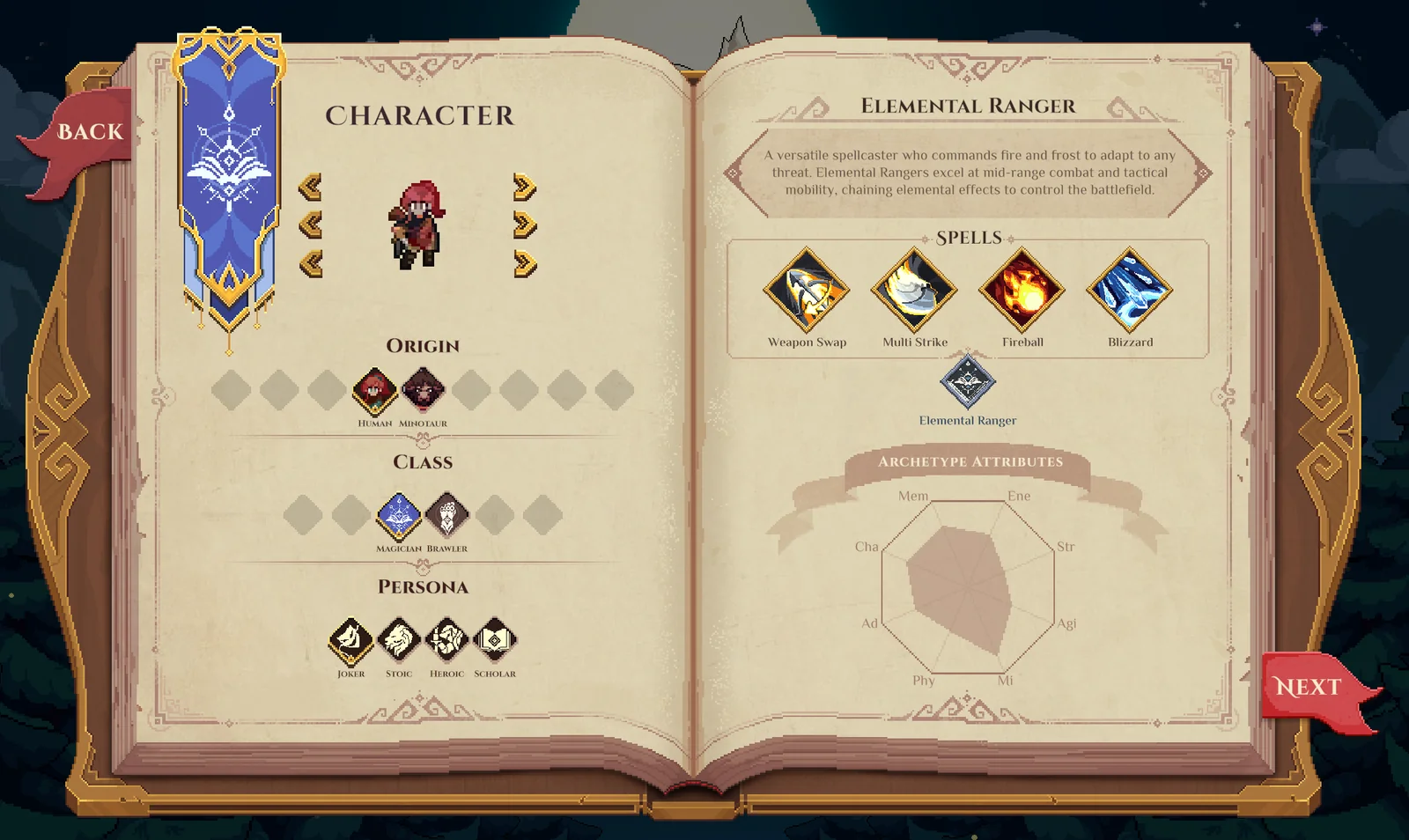
The development character creator places race and class in separate selections. Use the current Early Access roster above rather than treating every option in an older image as currently available.
The nine available class combinations
The current combinations are Human Brawler, Human Mage, Human Shadow, Minotaur Brawler, Minotaur Mage, Minotaur Shadow, Elf Brawler, Elf Mage and Elf Shadow. This list is a roster, not nine fully tested build recommendations. The concrete examples later on this page cover only some of those pairings.
If you know you want Mage but are unsure about the weapon rhythm, compare the three Mage pairings. If you know you want Human's switching kit but are unsure about the class contribution, compare the three Human pairings. This keeps one part of the decision stable instead of changing both at once.
Do not discard an unranked pairing merely because there is less detailed playthrough material for it. Lack of a complete example is a limit of the guide, not evidence that the combination is weak or unavailable. Inspect its starting actions and actual tree before deciding whether it matches the way you want to play.
Race remains part of every class choice
Race contributes the basic combat identity. Human has sword and crossbow switching, Minotaur has a deliberate melee rhythm and Elf is shown with dual daggers. Class contributes another set of spells and tree choices without erasing that starting identity.
Human Brawler, Human Shadow and Human Magician examples all include the Human switching kit. Weapon Swap is therefore not a reliable way to identify a character's class. It also should not be mistaken for a general system that equips any weapon found in a chest.
Elf Mage provides the same lesson from another direction. Daggers remain present alongside Fireball and Blizzard. Choosing Mage gives the character a caster direction, not a promise that all combat will happen at range or that ordinary attacks are no longer needed.
Use the Dimraeth races guide when the weapon rhythm is the part you are trying to choose. Keep the class constant while comparing races if you want a clearer impression of what the racial change contributes.
Brawler: plan the opening and the exit
Brawler should be evaluated as part of its actual combination. The Minotaur example begins with deliberate attacks and develops movement and effect interactions over time. A fresh character's first few swings do not describe every option the later build can acquire.
Start by learning when an attack is safe to commit. A longer action can leave the character exposed while it resolves. If the enemy begins a response before you finish, shorten the sequence or choose a different opening instead of assuming a damage upgrade will solve the timing problem.
Vortex changes the movement available to the demonstrated Minotaur Brawler. It can help reposition or leave danger, so a modifier that changes that behaviour affects more than the damage profile. Decide what will replace its movement job before choosing a less mobile form.
Brawler Bleed and resource responsibilities
The Bleed direction connects status application to follow-up benefits and changing resource choices. Keep track of which action applies Bleeding, which action benefits from it and which action generates or spends a resource such as Rage.
Those responsibilities can change when new skills become available. The demonstrated character revisits Vortex and Pulverize decisions rather than following one unchanged configuration from creation. Do not combine an early generator with a later spender without checking that both belong to the same selected setup.
Equipment can support the direction, but it should not disappear from the explanation. If a set effect or pet contributes to the sequence, inspect its condition and retain it when judging the result. A class label alone does not reproduce a developed character's support.
Brawler Blunt control is a separate interaction
A Minotaur Brawler keystone can convert basic attacks to Blunt damage. Blunt contributes strongly to hidden Stun Build-up, and filling the buildup stuns the target. That describes a control direction worth considering.
It does not prove permanent control of every boss or identify a universal number of hits. The conversion has prerequisites, and the complete current path is not supplied here. Evaluate the available actions before reaching it as well as the payoff you want later.
Bleed-focused combat and Blunt-control planning are different cases. Success in one should not be used as evidence that the other has been fully tested. The Dimraeth skill tree guide explains how race, class and archetype choices belong to different parts of a character.
Mage: organise spells around effects
Mage, also labelled Magician, is worth examining if you want spell effects to drive the decisions in a fight. That does not mean pressing damage spells indefinitely. The setup, resource recovery and timing between actions are part of the class experience.
A Human fire direction can begin with Fireball and Conflagration applying Burning. Oil can support spread, while a Combusting Fireball consumes existing Burning stacks for a payoff. Two fire-themed actions may therefore perform different jobs or compete for the same setup.
Choose the relationship you want before filling the bar. If one action spends the effect another action expects to remain, timing matters. In co-op, a teammate may also use those stacks, so discuss the sequence rather than assuming that matching elements automatically create synergy.
Mage modifiers and casting behaviour
Spells can use a press, held charge or channel. Read the selected behaviour and practise it in a manageable encounter. A brief tap is not a complete test of a spell designed to charge before release.
Modifiers can change that behaviour, and choices may be exclusive within an aspect. A Fireball with one selected variant should not be described as though it also has every alternative. After a modifier change, reassess both its role and the length of the opening it needs.
The Elf Mage example illustrates why copying a class route also requires attention to race. A class spell can appear on both Elf and Human while the connecting tree and archetype support differ. Use the actual selected combination when following a path.
Ordinary attacks remain part of casting
Landing basic attacks restores Concentration during combat. An attack that misses does not meet that condition, and a physical-damage active spell is not automatically the same recovery action.
The racial kit affects where and how you obtain those hits. Human's switching options offer one spacing decision; Elf's dagger example offers another. Check Weapon Swap's current tooltip before planning resource recovery around repeated switching; its resource type and cost are not verified here.
Shadow: positioning and a clear follow-up
Shadow belongs in the launch roster. Its name should not be used to invent an exhaustive stealth kit or a universal damage ranking. The concrete Bleed example includes positioning, Tendon Slice and Dark Convergence, with defensive pet support contributing to the case.
Start with the opening the selected action requires. If the sequence benefits from approaching behind or catching an enemy at the right moment, plan how you create that opportunity. Then identify the follow-up and the attacks that recover the resource for another attempt.
A teammate drawing attention can make that opening easier. A solo character may need a different timing decision. Keep party support in the explanation instead of presenting a co-op result as an automatic solo outcome.
The example's race is not assigned without a verified identity. A rogue-like fighting style does not establish that a character is Elf. Choose the racial basic kit you want, then inspect the available Shadow combination and its requirements.
Three tree layers and world spellbooks
Your visible tree combines race, class and archetype contributions. The pairing matters because the archetype adds interactions specific to that combination. Two characters with the same class label should not be expected to have identical complete trees.
World spellbooks provide another source of actions. Different race–class combinations can learn them when their requirements are met. This makes “only Mage can use magic” an unreliable rule, while still leaving room for exclusive tree paths and modifiers.
Obtaining a recipe, crafting a book, learning the spell and assigning it are separate steps. If a Brawler has a useful book but cannot cast it, inspect those steps before deciding the class is forbidden from using it.
The Dimraeth spell-equipping guide covers that process. The race, class and archetype tree explanation covers the distinction between a shared spell and the surrounding combination-specific support.
Five active spells require a plan
Dimraeth allows five equipped spells. A growing learned collection increases the options you can choose from, not the number of active slots. Equipment-triggered effects are also separate from a sixth manually equipped action.
Before adding a new spell, identify the job of the action it replaces. That slot may be the only movement tool, generator or setup for another action. Removing it can make the remaining bar feel unreliable even when the new spell is individually useful.
A practical starting plan is to identify your main setup, the payoff, the recovery rhythm and the response to a failed opening. Those jobs need not map to exactly one slot each. An action can contribute to more than one job, but a missing job should be visible in the plan.
Test one meaningful change at a time. That lets you recognise whether a modifier improved the sequence or merely moved the problem from damage to survival.
Choosing a class for a first solo character
Choose a basic kit you can land reliably and a class direction whose actions you enjoy. The character needs to function before its late interaction is complete. A distant powerful node does not compensate for disliking the ordinary combat needed to reach it.
For an effect-driven caster, examine Human or Elf Mage with their different recovery rhythms. For deliberate melee, examine Minotaur Brawler and the movement options available along the way. For positioning-led follow-ups, inspect a Shadow direction while accounting for how the opening is created alone.
Those are fit-based suggestions. No same-condition tests here establish a universal strongest solo class. A developed character with useful equipment and a defensive pet should not be compared with a fresh character as though the only difference were class.
If an early attempt feels weak, check the input, recovery and requirements first. A charged skill used with quick taps or a missing active assignment can create a misleading impression of the whole class.
Choosing complementary co-op characters
A party does not need one of each class to function. Two Mages can contribute different effects and timing, while two different classes can still interfere with the same setup. Discuss what each player will actually apply, consume or support.
Identify any dependency on a teammate. If your sequence expects another player to hold attention or supply Burning, say so when planning the loadout. That makes it easier to adapt when the party changes or someone explores alone.
Remember that services depend on the world. Characters travel with personal progression, while recruited allies and buildings remain associated with each world. A spellbook service available at a friend's established base may not yet exist in your own world.
For Persona, appearance and world selection, continue to character creation after choosing the class and racial kit.
For character planning, compare the Dimraeth best solo class options, the conditional Dimraeth tier list comparison and the Dimraeth best-build directions. Each separates supported interactions from unverified rankings or complete loadouts.