
Dimraeth base building is optional, and the useful starter base is Workbench → Pinewood Chest → recurring utility → production. Build inside the expandable Sanctum, solve the first Pinewood Plank bottleneck through exploration loot, and place practical stations before spending scarce components on walls or a large house. A few chests and crafting tables are enough to keep the story moving; farms, resource production, ally facilities, and decorative construction can follow when they solve a real need.
Mudtek's community reply explicitly describes base building as optional. You can place chests and crafting tables and stop there. That makes the Sanctum a progression tool rather than a mandatory architecture project. The right base is the smallest setup that reliably stores loot, processes materials, prepares consumables, and supports the character's next expedition.
Dimraeth base-building order
| Priority | Structure or system | Problem it solves | Reason to delay it |
|---|---|---|---|
| 1 | Workbench | Turns found materials into repeatable building components and tools | No reason once the opening blueprint and first planks are ready |
| 2 | Pinewood Chest | Stops materials and equipment from controlling inventory space | Delay only until the Workbench chain can supply its components |
| 3 | Useful crafting station | Produces the potion, food, tool, or other item the character needs | Do not build every station without a current recipe goal |
| 4 | Recurring utility | Reduces repeated gathering or preparation work | Skip if the utility does not support the current route |
| 5 | Farms and production | Creates a resource pipeline while the player adventures | Avoid overbuilding before basic storage is organized |
| 6 | Ally facilities | Expands services, inventory, or farming options as progression permits | Recruitment and service state come first |
| 7 | House and decoration | Personal layout and visual completion | It does not need to block the main story |
This order follows bottlenecks. If another structure is required by the active quest, complete it, but return to the same principle afterward: make the base improve the next trip.
Sanctum unlock and opening camp
The Sanctum appears after the opening Lost Caverns route. Recorded play shows the player meeting the opening mage there and later returning to place a crafting table. That location supports crafting stations, storage, housing, crops, facilities, and recruited characters.
Follow the active Sanctum objective instead of free-building immediately. If the Workbench is absent, reread the current objective and finish the requested interaction before searching for a hidden recipe. The evidence shows the crafting table becoming available through progression, not as an arbitrary world drop.
The build area is the Sanctum. One third-party page claims buildings can be placed anywhere and recommends Earlwood, but that conflicts with the developer description and documented Sanctum gameplay. Build in the area the game presents for construction.
The Dimraeth walkthrough covers the transition from Lost Caverns to the Sanctum and Earlwood. Use it when the base area exists but the village or next story route is still locked.
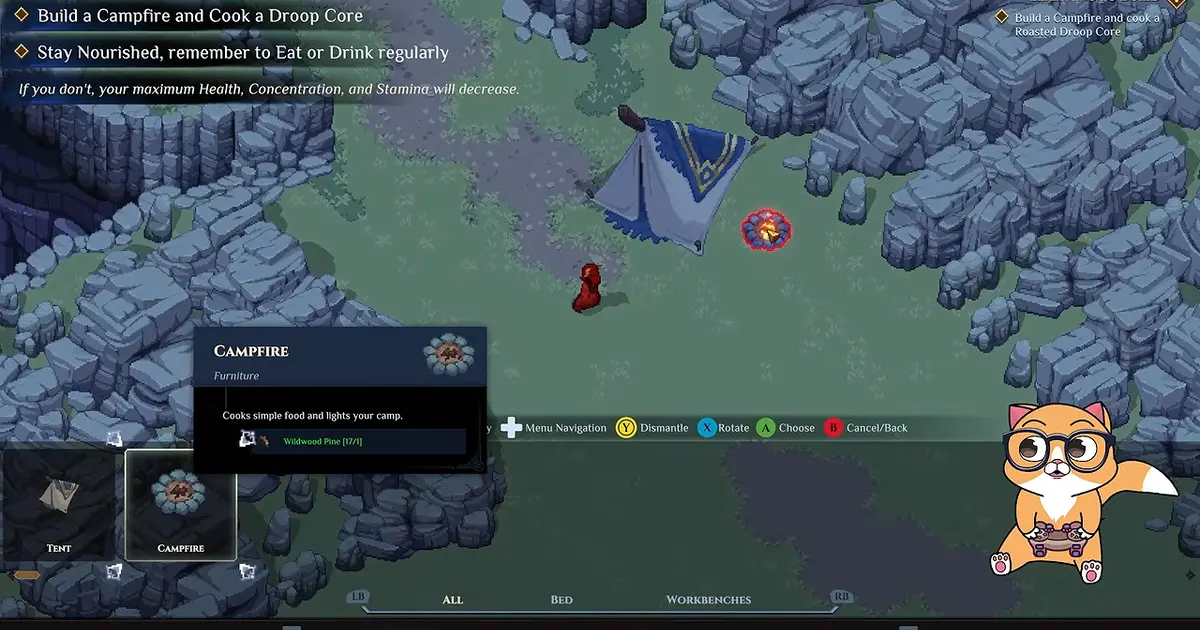
A compact Tent-and-Campfire setup illustrates the practical opening camp before production expands.
Workbench and the first-plank loop
The first Workbench can look impossible because it requires Pinewood Planks while also becoming the station that processes Pine into more planks. One Early Access route shows a two-plank requirement, but the live recipe is the authority if that number changes.
Get the bootstrap planks from exploration before trying to craft them. The dedicated Dimraeth Pinewood Planks route covers the Farmland search pattern and the later Wildwood Pine conversion without duplicating it here.
Once the required planks are secured, return to the Sanctum, place the Workbench in a clear interaction area and inspect its current recipes. Reserve the first processed output for storage and required stations; spending it on decoration can recreate the bottleneck.
The Dimraeth recipes guide explains raw and processed ingredients, tools, station selection, and why a recipe can remain unavailable even when related materials fill the inventory.
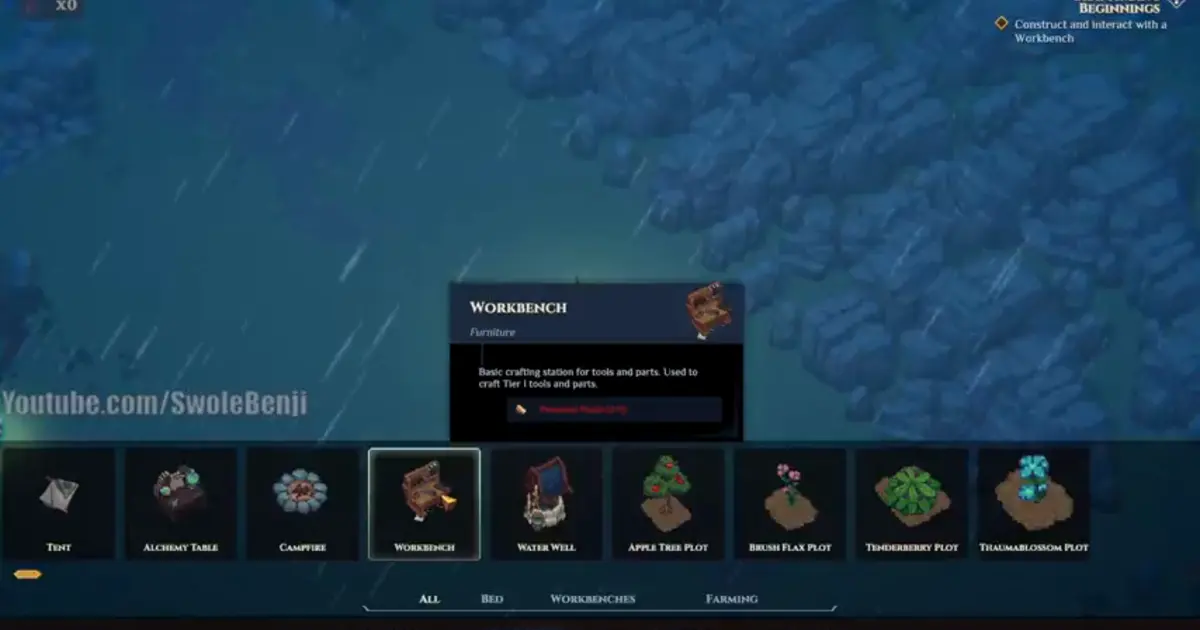
The Workbench build entry makes the first Pinewood Plank bottleneck visible before repeatable processing exists.
Pinewood Chest before a house
After the Workbench, build a Pinewood Chest. The opening route quickly mixes wood, stone, planks, nails, food, equipment, spell materials, boss parts, and quest items in the same limited inventory. Storage returns control to the player before larger projects multiply those categories.
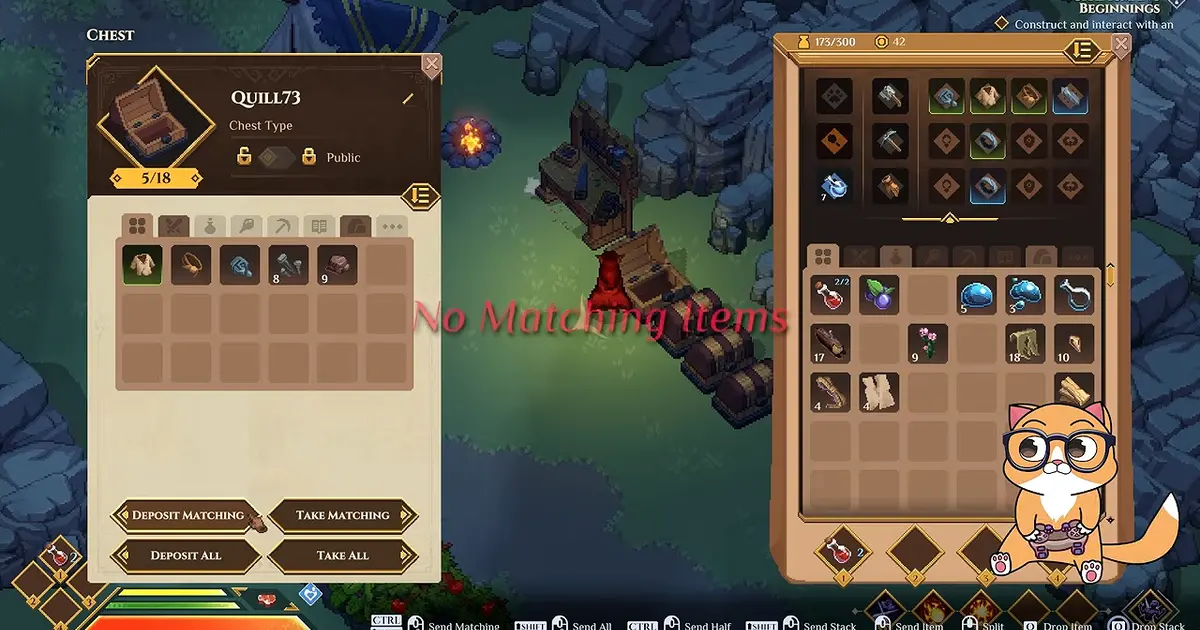
Deposit Matching shows why an early storage cluster improves the return-and-restock loop without requiring a finished house.
Place storage near the stations it serves, leaving enough space to target each interaction cleanly. One player deliberately avoids packing benches too tightly because selecting the intended station becomes awkward. A compact layout should reduce walking without creating overlapping prompts.
A simple opening arrangement is enough:
- one chest for raw and processed crafting materials;
- one chest for food, potions, and expedition preparation;
- one chest for equipment, sets, spell parts, or undecided valuables when needed.
Three chests are a practical player example, not a requirement. The Dimraeth storage guide covers the guild-hall chest, matching deposit, set-piece sorting, encumbrance, and missing-blueprint checks.
Crafting stations by current need
Build the station required by the next useful output. The documented base demonstrations include a Workbench and Alchemy Table, while the wider design supports cooking and equipment-related services. That does not mean every station deserves immediate materials.
Use a need-to-station mapping:
| Current need | Base action | Verification before spending |
|---|---|---|
| More construction components | Use the Workbench | Check the exact processed item and output quantity |
| Gathering tools | Inspect Workbench tool recipes or continue the route that supplies tools | Verify whether crafting or quest progress is cheaper now |
| Better potion preparation | Inspect the Alchemy Table and current potion chain | Check whether the recipe upgrades an existing item |
| Reliable food | Add the cooking structure supported by the active blueprint | Read the food effect rather than cooking every ingredient |
| Spellbook or service craft | Visit the appropriate recruited service | Confirm the NPC and material requirements first |
| Equipment improvement | Use the relevant upgrade service or station | Distinguish reinforcement from crafting a new item |
The base should not consume all materials intended for the character. If a new station has no recipe you plan to use, keep the components for equipment, a spellbook, or a more immediate utility.
Farms and passive production
documented Early Access footage shows apple trees placed in the Sanctum and described as generating resources while the player adventures. Other material describes farms, quarries, crafting stations, and allied facilities as parts of the wider resource pipeline.
Production is valuable when it replaces repeated gathering for an item you use. Place a small amount, leave the Sanctum, and check the actual output after a normal quest interval. Expand only when the result has a destination such as food, crafting, trade, or another facility.
Do not assume every resource has an automated building or that every farm works without progression. No complete structure catalogue, timer, output-rate table, or worker-requirement list is currently documented. Read the live building description and service interface.
Food production is one supported reason to engage lightly with the system. Community players report using crops to make routine nourishment easier and choosing stat food for harder fights. That is a practical option, not proof that cooking or farming is mandatory to finish the story.
Passive production should free the player to explore. If maintaining a large farm consumes more attention than it saves, shrink the operation to the resources actually used.
Recruited characters and facilities
Important NPCs can move into the base through quest and relationship progression. Available documentation says recruits may open upgrades, services, farming options, and even access to pets. Their presence turns the Sanctum into more than a storage yard.
Recruitment and construction are separate. Completing a character's request can bring that service to the Sanctum even if the player has not built a large house. Mudtek's explanation says base building itself can remain minimal.
When a service is missing, diagnose the NPC's progression before building unrelated structures. Check the character's request, invitation state, current dialogue, and whether they are physically present. There is no documented universal “NPC house” recipe that must be built for every recruit.
Place the practical work area near the travel and service core when possible. One player prefers that arrangement because returning, speaking to NPCs, depositing materials, and crafting become one short loop. The evidence is not strong enough to claim NPCs can never move, so treat the layout as convenience rather than a permanent rule.
For companion progression after Myrll arrives, use the Dimraeth pet guide. It distinguishes recruiting the service NPC from unlocking and acquiring an individual companion.
Compact layout for daily use
Organize the Sanctum by action sequence:
- Arrival and unloading near storage.
- Processing raw materials at the Workbench.
- Crafting the consumable or upgrade needed for the next route.
- Visiting recruited services.
- Restocking carried items.
- Leaving through the travel point.
Keep paths clear and leave interaction space around stations. Group related structures without forcing every object into one dense block. Farms and larger production can sit outside the high-frequency crafting core because they are checked less often.
Reserve an open patch for quest-required structures. The Sanctum expands in the developer description, and later facilities can need more room than an early bench. An open area is more useful than a speculative empty house shell.
If a placed object blocks the flow, the recorded build route shows chests can be moved. Check the current building controls and reposition it rather than rebuilding the entire base. Not every structure is confirmed to share identical move rules, so verify the selected object before dismantling.
Minimal base for players who dislike building
You can keep the system small. Mudtek says base building is optional, and a community player describes recruits functioning as vendors without requiring extensive buildings for them. The lean version is:
- the opening structures required by progression;
- one Workbench;
- enough Pinewood Chests to keep materials usable;
- only the crafting stations needed by the current build;
- a small food or production source if it saves repeated gathering;
- recruited services earned through quests.
Skip walls, flooring, a Pinewood house, and decorative expansion until they are wanted for their own sake or the game explicitly requests them. This keeps the action-RPG route central while preserving the benefits of storage, processing, and preparation.
Optional does not mean irrelevant. A minimal base still removes encumbrance, turns raw materials into components, prepares potions or food, and centralizes services. The choice is how deeply to invest, not whether the systems exist.
Base-building troubleshooting
| Symptom | Supported cause to check | Next action |
|---|---|---|
| Workbench blueprint missing | Opening Sanctum progression is incomplete | Finish the current objective and the opening-mage dialogue |
| Workbench needs planks before planks can be crafted | First-plank exploration loop | Check town storage, chests, bodies, and searchable log spots |
| Pine does not satisfy the recipe | Raw and processed items differ | Obtain the initial planks, then process Pine at the bench |
| Pinewood Chest is absent | Blueprint or quest state has not advanced | Recheck the opening build sequence before hunting a random recipe |
| A station is hard to select | Objects are packed too tightly | Create interaction space or move supported structures |
| Base consumes all upgrade materials | Construction priority is too broad | Build only the station or utility that solves the current blocker |
| Recruit service is absent | NPC progression is incomplete | Finish the character request and invitation sequence |
| Farm feels unhelpful | Output has no planned use | Test a smaller production loop and expand only useful supply |
If a structure requirement differs from this page, follow the current interface. Early Access recipes and balance can change. Preserve the version and displayed recipe before reporting a mismatch.
Base loop between quests
Use the Sanctum as a short reset rather than a second campaign:
- Deposit loot into organized storage.
- Read new ingredients and preserve anything tied to a planned recipe.
- Process the raw materials needed by the next structure or craft.
- Queue useful station output.
- Check recruited services for the intended book, upgrade, or companion.
- Restock and return to the main objective.
Apply rewards before gathering again. If the Workbench made planks, place the chest. If a boss material completes a book, craft it. If a farm supplied food, prepare the piece that helps the next fight. Resources stored without a plan do not improve the character.
Early Access evidence boundary
The evidence supports an expandable Sanctum, optional base building, a minimal chest-and-station approach, the Workbench-first order, exploration-sourced initial Pinewood Planks, repeatable plank processing after the bench, early storage, crafting stations, farms, passive production, recruited services, and later upgrades.
It does not support a complete building catalogue, exact production timers, universal placement freedom outside the Sanctum, mandatory NPC houses, fixed co-op permissions, or one optimal floor plan. A third-party page that places the first base around Earlwood conflicts with stronger Sanctum evidence and is not used here.
Build the practical core, test what it saves, and expand only when the next structure improves storage, preparation, production, or a service the character will actually use.