
This Dimraeth Recipes guide covers crafting basics and fixes for blocked crafts, with selected examples rather than a complete current recipe database. Start with the workbench tutorial, then use the correct station and the exact ingredients shown by your selected recipe. A missing item can mean several different things: you have not learned its recipe, you are at the wrong station, you have raw materials instead of processed ingredients, or the relevant NPC service has not been unlocked. Buying or gathering more of the same material will not solve every one of those problems.
For an early character, the useful order is gathering tools, basic processing, the workbench and alchemy steps, then the consumables or spellbook you actually need. Keep your next objective small. Making one usable potion or one learnable book is better than spending all your materials on a collection of unfinished projects.
Dimraeth recipe discovery and the Crafting Codex
Recipes enter your collection through exploration and ingredient combinations. The Crafting Codex helps connect a material to things made from it. It is particularly useful when a newly collected monster part looks like vendor junk but belongs to a recipe you have not discovered yet.
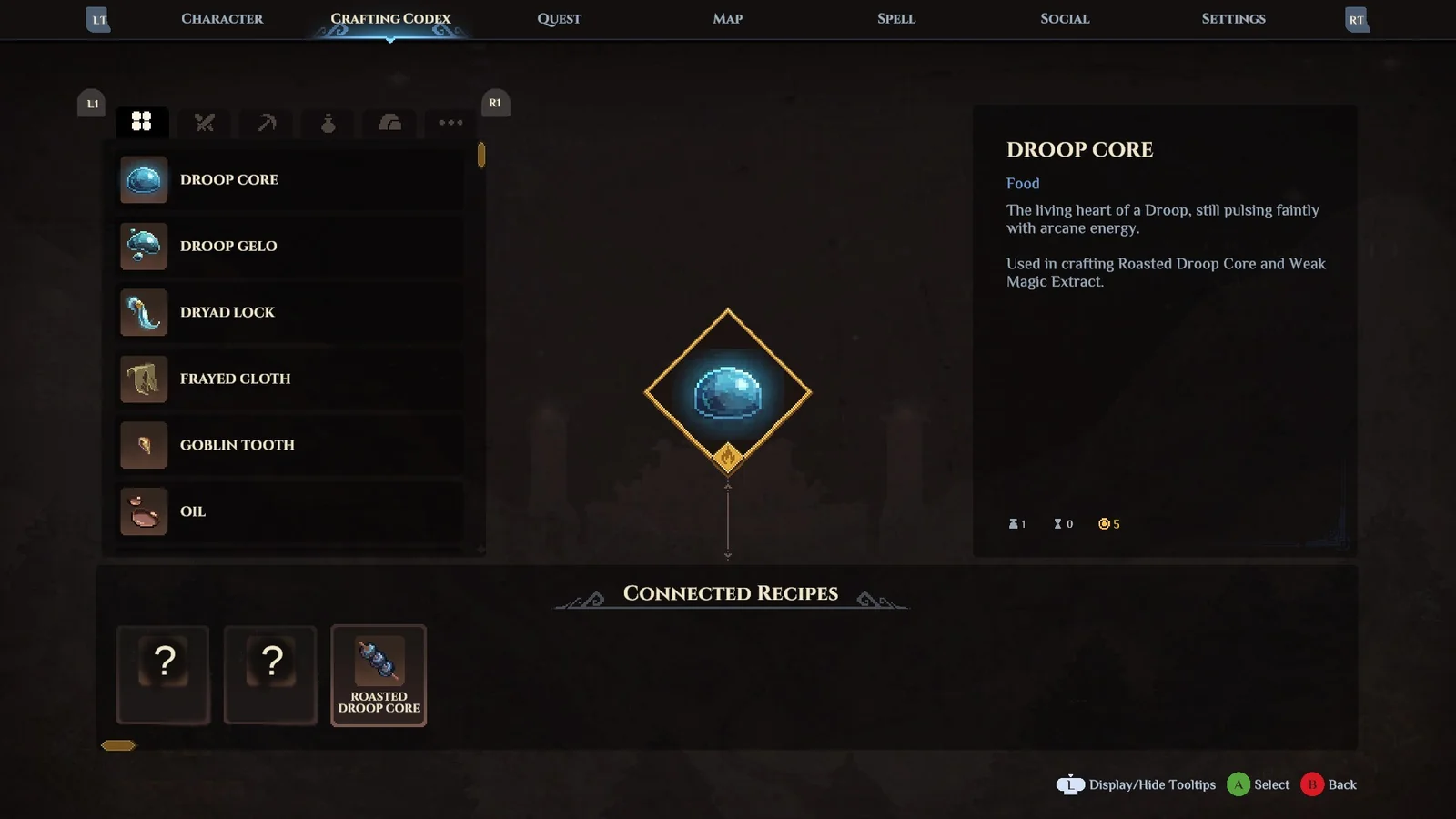
The development interface shows Droop Core selected on the left, its description on the right and connected recipes below. Question marks indicate undiscovered connections; this image is not a current quantity chart.
Read the selected ingredient's description before following a connection. In this example, the description connects Droop Core to Roasted Droop Core and Weak Magic Extract. That tells you which products to investigate. It does not tell you that Droop Core alone is sufficient, or that the same ingredients and quantities apply to every product in that family.
The useful distinction is between knowing an ingredient has a purpose and having a complete recipe. A question mark is a discovery lead. A named recipe is something you can inspect for its actual requirements. Do not empty a rare material stack just because several unexplored connections appear beneath it.
When experimenting, use spare materials and inspect the proposed output before committing. Keep scarce monster parts for an intended book or upgrade until you know what the alternative produces. This is a resource-management recommendation, not a claim that every material is rare or that failed combinations always consume ingredients.
Workbench and alchemy progression
The opening construction sequence links several actions: recovering materials from a tent, constructing a workbench, interacting with that workbench, then progressing to an alchemy station and extract-making. Building a station and completing its tutorial interaction are separate actions. If the next objective has not appeared, revisit the station and the active task before building another copy.
Use this order when the tutorial seems stuck:
- Read the current objective rather than the objective you remember from the previous step.
- Confirm that the required structure has actually been placed.
- Interact with that structure and inspect the available recipes.
- Check whether the next ingredient is a processed product, such as a plank, rather than the raw resource in your bag.
- Craft the requested output and check the objective again.
The early sequence is useful beyond the tutorial because it introduces the same distinctions that cause later crafting failures. A station can exist without being the station required by your selected recipe. A bag can contain plenty of wood without containing the named wooden product. A recipe can be known while its required service is still unavailable.
Early construction recipe examples
The following quantities belong to the pre-release build examples used for this guide. Treat the recipe displayed in your installed version as decisive if it differs. These examples explain the ingredients to look for; they are not a complete Early Access recipe database.
| Construction | Recorded ingredients | Practical check |
|---|---|---|
| Tent | 4 Wildwood Pine and 1 Frayed Cloth | Check both the wood type and the cloth entry |
| Alchemy Table | 2 stone nails and 5 pine planks | Process the required parts; raw stone and wood are different items |
There is no reliable material-location map attached to these two examples. Avoid turning the table into a farming route by guessing which container or creature drops the cloth. For a known recipe, inspect each missing ingredient in the Codex and compare it with your inventory before leaving town to gather.
Gathering tools must be equipped
A resource you can see is not necessarily a resource your character can harvest yet. Early crafting introduces gathering equipment, including gloves, axes and picks. Check the required tool and its equipped state before assuming that an unresponsive plant or resource node is broken.
One easily missed problem is making the tool but leaving it in the inventory. The gathering-glove example is especially useful: possessing the gloves and equipping them are separate steps. If collection still fails after crafting a tool, inspect your equipment before spending materials to craft a second one.
Do not use one successful harvest to infer that the tool works on every resource. Higher requirements, different tool categories or another interaction may still apply. This guide does not assign unverified tool tiers to plants or deposits.
For a gathering trip, take the tool you need and enough free carrying capacity for the ingredients you intend to bring back. Wood products and stone can accumulate quickly. If movement becomes noticeably slower after collecting construction supplies, check weight before changing your combat build. The Dimraeth movement guide covers that diagnosis separately.
Raw ingredients and processed ingredients
Recipe names are exact item requirements. A plank is a processed ingredient, not a shorthand for any piece of wood. The same distinction applies when a recipe asks for a nail, extract, vial or already crafted consumable. Inventory space filled with related materials does not necessarily satisfy the listed requirement.
A practical way to follow a chain is to work backward from the final item. Inspect the output you want, identify the missing processed ingredient, then find the recipe that makes that ingredient. Stop once you reach materials you already have or can deliberately obtain. This avoids crafting unrelated intermediate products just because their recipes are available.
Before making a large batch, confirm three things in the interface: the item selected, the quantity produced and the materials consumed. A recipe for an ingredient and a recipe using that ingredient may sit close together. Reading the output prevents you from making another raw intermediate when you meant to finish a potion.
Storage can help keep the trip manageable, but do not assume every chest anywhere in the world supplies every station. If an ingredient appears missing while you own it, compare carried and stored quantities and retry with the required amount available to the crafting interaction. The precise storage-access rules can depend on the situation; the important check is where the recipe is actually counting your materials.
Potion crafting, upgrading and refilling
Making a potion, improving it and restoring its charges solve different problems. A new potion adds an item to work with. An upgrade improves an existing item. Resting replenishes combat-item charges in the demonstrated rest system. Repeatedly crafting basic potions is not automatically the right answer to an empty charge indicator.
Potion upgrades can use the previous version of the item. A +0 potion becoming +1 is a progression chain, not merely two unrelated recipes. Select the upgrade for the item you own, then inspect its requirements and output. If the next step expects a lower-tier finished potion, gathering its original ingredients again may leave you with the wrong input.
The same lesson appears with oil consumables: follow the actual upgrade chain rather than assuming that selecting the highest-looking entry skips the earlier stages. No universal maximum potion level or charge count is established here, so compare the displayed result before spending materials.
| Your problem | First thing to inspect | Action that addresses it |
|---|---|---|
| No potion item | Known recipes and the required station | Make the appropriate base item |
| An owned potion is too weak for your needs | Its next upgrade and required inputs | Upgrade the existing item if the displayed trade is worthwhile |
| The equipped potion has no charges | Rest state and the charge indicator | Rest, then check the item again |
| A potion exists but is awkward to use in battle | Its prepared combat-item slot | Set up the slot before the next encounter |
Rest at a suitable campfire or bed and check your item charges before setting out. Do not assume death itself performed every preparation step. It is possible to return to combat with an item prepared but still overlook whether its usable charges have recovered.
Spellbook recipes and recruited services
A spell recipe is not a learned spell. A recipe can lead to a crafted book; that book can still require attributes before you learn and use its spell. If your goal is a new action on the spell bar, keep following the process after the crafting step.
Spellbook crafting includes NPC services using monster materials. Recruitment, quests and facility progress can affect which services and options are present. The person who makes one set of books is not necessarily the source of every book in the game.
Before farming, inspect the actual book at the service that offers it. Note the materials and the spell's learning requirements. A successful crafting trip is less useful if you spend the rare ingredients on a spell your current attributes cannot support and have no immediate plan to train those attributes.
Rough Paper is one example of a material that can stop an otherwise ready book craft. It appears as a collected item in the playthrough material, but there is no verified guaranteed chest route here. Check your existing supplies and the relevant recipe rather than treating an arbitrary chest as a promised source.
For boss-related ingredients, distinguish ordinary world encounters from repeatable activities. Guild Deeds provide repeatable boss and dungeon content after the relevant progression. That gives you an avenue to investigate when a one-time story encounter is no longer present. It does not establish a specific Deed's unlock condition, timer or guaranteed material drop.
The Dimraeth spell-equipping guide continues from obtaining the book through requirements, learning and the active loadout. Use it if crafting succeeds but the spell still does not appear where you expect.
Equipment upgrades are a different process
Dismantling an existing piece, spending reinforcement materials and crafting a new piece from raw ingredients are different operations. Keep those distinctions when deciding what to do with unwanted equipment. An anvil upgrade is not evidence that the same equipment can be manufactured from scratch.
Before dismantling, compare the piece with your current set requirements. A weaker-looking individual item may still contribute to a set effect you are using. Check what equipping or removing it does to the set count before treating its standalone statistics as the whole decision.
Likewise, upgrading one item does not automatically preserve every part of a build when you later replace it. Your spell choices may depend on an effect granted by a set. If the build changes after an equipment swap, inspect the active set effects as well as the new item's larger numbers.
This page does not list a complete equipment-crafting catalogue. The useful supported operations are ingredient processing, consumable and spellbook production, plus separately identified dismantling and reinforcement. Keeping those jobs distinct prevents wasted trips to the wrong service.
Fixing a recipe that will not craft
Start with what the interface says is missing. If the recipe itself is absent, investigate discovery, the selected crafting category and service progression. If the recipe is present but unavailable, inspect its individual requirements. Those are different branches of the same problem.
| Symptom | Check | Avoid this mistaken conclusion |
|---|---|---|
| Recipe is absent | Discovery, station and service inventory | Every NPC should sell or craft the same things |
| Wood or stone is present but the requirement fails | Exact ingredient name and processing stage | Raw material is interchangeable with a named component |
| Gathering still fails after making a tool | Equipped tool and the target's requirement | Crafting the tool automatically equipped it |
| Upgrade cannot be selected | Previous-tier item and upgrade ingredients | A higher-tier recipe replaces the entire chain |
| Book was made but no spell can be used | Learning requirements and active assignment | Crafting immediately put the spell on the bar |
| Item use becomes unavailable during danger | Combat state and prepared slots | The item was deleted or its recipe is broken |
Prepare consumables and check materials in safety. Backpack access can be restricted during combat, so leave inventory changes until after the encounter rather than relying on a mid-fight crafting fix. This does not mean every possible menu operation shares the same restriction.
When returning to base, deal with the bottleneck that stopped you: complete the workstation interaction, process the missing component, equip the gathering tool, improve the correct service or train for the spellbook you made. That is a more productive next trip than gathering another full bag without knowing which requirement remains unmet.
For examples of where to start looking before crafting, see the Dimraeth spellbook location leads. That guide distinguishes reward and exploration leads from a finished, learnable book.