
The Dimraeth Early Access races are Human, Minotaur and Elf. Each can be paired with Brawler, Mage or Shadow, producing nine available race–class combinations. Race affects the basic combat kit and contributes to the skill tree; class adds another layer rather than replacing the racial identity.
Choose the race whose ordinary combat actions you want to use repeatedly. Those attacks remain relevant when spells run out of Concentration, so the starting weapon style is more than a cosmetic preference. Then compare classes within that race to find the spells and interactions you want to develop.
Dimraeth races at a glance
| Race | Basic-kit examples | What to consider before choosing |
|---|---|---|
| Human | Sword and crossbow, with Weapon Swap | Whether switching between close and ranged attacks suits your combat rhythm |
| Minotaur | A heavy melee rhythm, with racial charging and quaking themes | Whether you enjoy deliberate attacks and want to build around openings and movement tools |
| Elf | Dual daggers in the demonstrated starting kit | Whether you want that close-range weapon identity alongside your selected class spells |
This comparison describes available kit differences, not measured damage or speed rankings. It does not say Human always wins at range, Minotaur is automatically the safest beginner character or Elf has the highest damage. Those conclusions would require comparable builds and encounters.
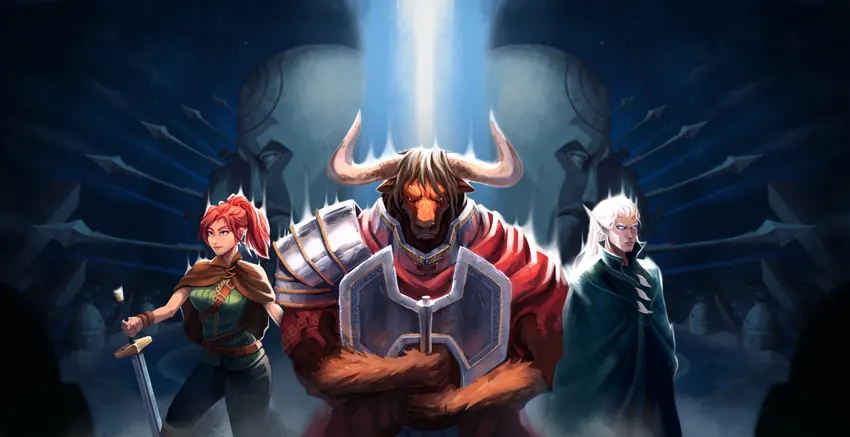
Human, Minotaur and Elf in Dimraeth artwork. Their weapon and body silhouettes help distinguish the three available racial identities.
The current three-race roster should not be confused with larger promotional plans. Older descriptions discuss more races and many more combinations. Those counts describe a broader intended game, not extra choices that you should expect to unlock in the current character creator.
Human weapons and Weapon Swap
Human's sword-and-crossbow identity appears across different classes. Human Shadow, Human Brawler and Human Magician examples all show weapon-switching descriptions. It is therefore misleading to treat Weapon Swap as proof that a character belongs to Shadow or has changed class.
The useful decision is how you want to move between engagement distances. A sword form and a crossbow form give you different ways to approach the next opening. That can be attractive if you like a character whose basic attacks are not limited to one spacing pattern.
Check Weapon Swap's current tooltip for its resource type and any cost; neither is verified here. Choose the form that serves the next part of the encounter, then observe the resource display when switching. Do not assume that switching itself restores Concentration.
This matters for a Human Mage as much as a Human Brawler. A caster still needs a recovery rhythm between spells. Human's basic-kit options can help you plan that rhythm, but they do not remove the requirement to land the relevant basic attacks or pay the costs of your actions.
Choosing a Human class
Start by holding the racial part of the choice constant. Compare Human Brawler, Human Mage and Human Shadow rather than comparing a Human caster with a developed Minotaur melee character and attributing every difference to race.
A Human fire direction can centre on Burning, with spells such as Fireball contributing an effect that later actions use. A Human Shadow has a different class contribution while retaining the same racial weapon identity. The class decision is therefore about the larger set of interactions, not simply whether a crossbow exists.
Do not choose Human on the assumption that every dropped weapon can replace the racial kit. Weapon switching within that kit and unrestricted equipment swapping are different mechanics. Read the actual equipment and action descriptions before building around a weapon category you have not used.
Minotaur attack rhythm and mobility
Minotaur's heavy opening attacks can feel deliberate. That makes the timing of an attack matter: choosing an unsafe opening can leave you committed while an enemy responds. The solution is to learn the action's timing and the space you need, rather than expecting a heavy attack to behave like a short dagger strike.
The starting impression is not the entire developed character. A Minotaur Brawler gaining Vortex can acquire a valuable way to move through or away from danger. That changes encounter flow even though it does not establish a new ordinary running-speed statistic.
When evaluating Minotaur, consider the full sequence you want to perform: close the distance, attack during an opening, then leave or reposition. A movement skill can be as important to that sequence as another damaging skill. Removing it for a modifier or a different action should be a deliberate trade.
The same race can also choose Mage or Shadow. Minotaur is not a locked synonym for Brawler. Its racial contribution remains, while a different class changes the other parts of the tree and the spells you are developing.
Minotaur control and Bleed are separate directions
Minotaur Brawler has a described interaction that converts basic attacks to Blunt damage. Blunt contributes strongly to the hidden stun buildup system. That gives the combination a supported control direction, but it does not mean every Minotaur begins with that conversion or every Brawler build uses it.
A Bleed-focused Minotaur is a different example. It can involve applying Bleeding, gaining benefits against affected targets and managing resources such as Rage. Footage of that character performing well does not prove the results of a fully allocated stun build.
Use the distinction when choosing a race: identify the interaction you want, then confirm its prerequisites in the relevant combination. Do not treat a later keystone as a racial passive already present on a fresh character.
Elf daggers with a caster class
An Elf Mage example shows dual daggers alongside Fireball and Blizzard. That is a clear illustration of race and class doing different jobs. Selecting a caster class does not erase the racial weapon kit or turn every action into a ranged spell.
For a player considering Elf Mage, the practical question is whether the dagger-based recovery rhythm fits the spells you want to use. Plan where ordinary hits belong between casts and how you will leave danger after committing to them. The presence of ranged magic does not mean the whole encounter can be played without thinking about weapon range.
The spell side can also change through modifiers. A Fireball variant that affects an area asks for a different decision from one focused on another behaviour. The surrounding Elf combination must still be considered; a path shown on an Elf tree should not be copied onto Human merely because both characters are Mages.
This guide does not assign an unverified complete racial spell list to Elf. The useful established example is the coexistence of the dagger kit and the class spells. That is enough to compare the basic play pattern without inventing missing racial abilities or numerical advantages.
Race and class form the archetype
The selected pairing contributes an archetype layer as well as the racial and class layers. Two Brawlers of different races can therefore share a class label while having different starting actions and combination-specific interactions.
The reverse is also useful: two Humans of different classes retain a common racial identity while building toward different effects. If you are uncertain which choice changed the playstyle, compare one variable at a time. Hold the race constant when examining class, or hold the class constant when examining race.
| Choice you change | What deserves another look |
|---|---|
| Race, keeping the class | Basic kit, racial tree contribution and the resulting archetype |
| Class, keeping the race | Class spells, class contribution and the resulting archetype |
| A world spellbook | Attribute requirements and the active loadout |
| A modifier within the same character | The altered behaviour and what it replaces |
The Dimraeth race, class and archetype tree guide explains these layers in more detail. The key selection lesson is that neither race nor class should carry the entire comparison alone.
Attribute costs and spellbook choices
Race and class both influence attribute-training costs in the documented character system. That can affect how efficiently a particular combination develops toward a chosen set of requirements. It does not mean the cheapest-looking attribute should receive every investment.
Choose a near-term action you want to use, inspect its requirements and compare the training needed. A book that asks for attributes outside your main direction may still be useful, but the cost should be part of the decision. Do not assume that a spell's theme makes it free for your class.
World spellbooks broaden the available options across race–class combinations. This is why “Minotaur cannot use fire” or “only Mage can learn spells” is too crude a rule. At the same time, a universal book does not grant every exclusive modifier from another combination's tree.
Keep acquisition and eligibility separate. Owning a recipe does not mean you have made the book, and owning the book does not mean the current attributes meet its requirements. The Dimraeth spell-equipping guide covers those stages without confusing them with race selection.
Choose a race for solo play
For a first solo character, begin with the ordinary action you enjoy and can land reliably. You will use it when setting up effects and restoring Concentration. A theoretical late-game interaction is less helpful if you dislike the combat rhythm needed to reach it.
Human is worth trying if the sword-and-crossbow arrangement interests you. Minotaur is worth trying if you enjoy deliberate melee commitments and want to develop tools that support them. Elf is worth trying if the dagger identity appeals to you alongside the chosen class's spells. These are fit-based suggestions, not a universal ranking.
Then check the character's response to a bad opening. Identify how you reposition, when you can safely recover resources and which action you should stop using when the enemy begins an attack. The answer may involve skill selection or timing rather than choosing a different race.
A developed character with a movement skill, useful equipment and a prepared potion will naturally offer more options than a fresh character. Do not attribute all of that improvement to race when comparing screenshots or remembered encounters.
Choose a race for co-op
Co-op does not require each player to choose a different race. Two characters can share a race while filling different roles through class, modifiers and selected spells. Likewise, different races do not guarantee that the group's chosen effects work well together.
Discuss the action sequence you want to coordinate. If one player applies Burning while another consumes it, the timing matters. If both players expect the other to create the opening for resource recovery, neither may get a comfortable casting rhythm.
Human's changing engagement range, Minotaur's committed melee actions and an Elf caster's mix of daggers and spells can all produce different positioning needs. Use those needs to plan where each player stands, rather than assigning a fixed party role from the race name alone.
For shared-world services and personal progression, see character and world selection.
A slowdown is not automatically a racial weakness
Before comparing movement between races, check carrying weight, exploration sprinting and the action currently being performed. A character returning with construction supplies is not a fair comparison with an empty-handed fresh character.
Likewise, compare ordinary movement separately from a skill that moves the character. Gaining Vortex changes the actions available to a Minotaur build; it does not by itself prove a different base running-speed statistic. If a recent modifier removed that movement, inspect the modifier before blaming the race.
The Dimraeth movement guide provides a short troubleshooting sequence. Use it when the character suddenly feels slower, then return to the race decision only if the basic kit itself is what you dislike.
Appearance, Persona and trying another character
Appearance and Persona are additional creation choices. Colours let you distinguish the character visually, while Persona relates to dialogue tendencies. Neither should be confused with changing the racial basic kit or selecting a different class tree.
If you want to compare another combination, creating a separate character is a distinct action from changing the race of the existing character. New-character access to an existing world does not prove that race or class can be changed on the same hero.
There is no verified same-character race-change procedure in this guide. Do not choose a race on the assumption that a skill reset will later replace it. Attribute respec, skill respec, spell reassignment and race selection refer to different parts of the character.
The Dimraeth character creation guide brings those decisions together. Before confirming, check the race, the class and the basic actions you expect to use. Then treat the first few encounters as a chance to learn that combination's rhythm, rather than as a contest against an unsupported best-race label.
See the Dimraeth race-locked weapons guide for the distinction between a racial basic kit and equipment effects. For a Minotaur-specific interaction, the Minotaur Brawler stun-build guide explains Blunt conversion and its limits.