
No complete current Dimraeth Elf Mage allocation, named end-game equipment set or verified rotation is available here. Use this as a planning method: choose a small spell interaction, meet every attribute and resource requirement, and buy the connected tree path without inventing a copy-and-paste loadout.
Elf determines the racial weapon context: fast twin-dagger attacks rather than the Human sword and bow or the Minotaur axe. Magician contributes the magical direction, with fire and frost named in the documented character-system overview. Outside spellbooks can broaden the setup, but they still have attribute requirements and resource costs. Build those pieces together rather than spending every point on one attractive stat.
Dimraeth Elf Mage build at a glance
| Layer | Practical choice | Evidence boundary |
|---|---|---|
| Race weapon | Elf twin daggers and faster attack identity | Supported by character-system demonstrations; exact attack values are not supplied |
| Class direction | Magician fire or frost route as a starting identity | Named in the documented explanation; no complete Elf Mage route is documented |
| Core interaction | One spell that applies or creates an effect, plus one action that benefits | Build demonstrations support interaction-first planning |
| Attributes | Meet spell requirements first, then support the dominant resource and damage plan | Exact final totals depend on chosen spells and current tooltips |
| Skill tree | Count every connecting node to the chosen destination | The tree is connected; no free jump to a distant node is established |
| Gear | Use pieces that reinforce the chosen interaction and keep costs sustainable | No verified Elf Mage best-in-slot list is available |
| Defense | Preserve movement, recovery and enough durability for the content being attempted | No universal health target is established for this setup |
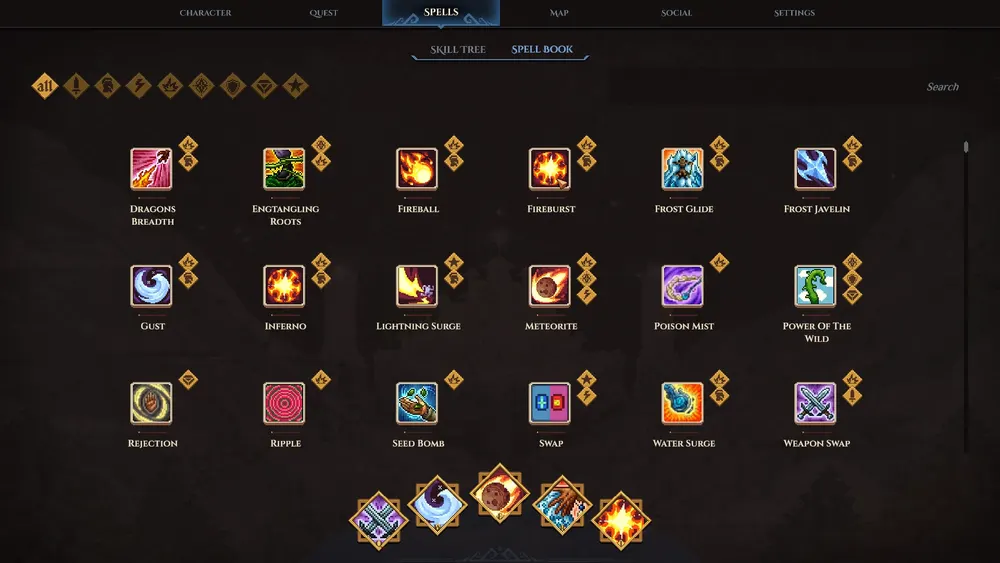
The spellbook and equipped slots illustrate the part of the interface that must be checked. This image is not an Elf Mage loadout and does not prove a recommended spell selection.
Evidence boundary for this build
Most current build videos in the available records demonstrate Elf Shadow, Minotaur Brawler or general character systems rather than a finished Elf Mage. One community post asks for help with an Elf Mage and contains a reply about using a grouping spell with another effect and a defensive pet. That is a player suggestion, not a verified complete build.
A third-party page labels the pairing with an archetype name, but a search title or snippet is not enough evidence to establish the current in-game label, skill list or passive. This page therefore uses the plain, verified race-and-class description: Elf plus Magician.
The absence of a complete loadout matters. A real guide should distinguish a planning framework from a tested preset. The framework below tells you how to validate your own current tooltips. It does not claim that a named skill, set or pet is mandatory when the source material cannot prove that.
Race, weapon and class roles
The racial choice affects the weapon available to the character. documented explanations describe Elf as the fast twin-dagger option, Human as sword or bow, and Minotaur as axe. An Elf Mage is therefore not simply a generic staff caster with a cosmetic race. Its ordinary weapon actions remain part of resource recovery, positioning and downtime between spells.
Magician is the class direction. In the documented character-creation overview, fire and frost remain part of the Magician identity across race pairings, while the racial weapon and combination-specific tree areas change the result. This is enough to justify starting from a fire or frost spell interaction, but not enough to declare that every Elf Mage must specialize in one element.
If the desired play style is sustained ranged spellcasting, test whether the chosen spells can cover ordinary encounters without leaving the character unable to recover. If the desired play style is a dagger-and-spell hybrid, check whether melee actions actually solve the resource gap and whether the required attributes support both halves. Do not call a build hybrid merely because it equips one spell and uses racial attacks.
The Dimraeth race-locked weapons guide helps confirm the weapon decision before investing in the rest of the character. Changing class does not replace the racial weapon context shown in the evidence.
Core spell interaction
Build around an interaction, not a list of individually impressive tooltips. The supplied build demonstration recommends identifying what starts an effect, what builds or converts it, and what consumes or benefits from it. That structure remains useful even though the demonstrated character is not an Elf Mage.
For an Elf Mage, write the loop in four slots:
- Opener: the action that safely starts the intended effect or creates space.
- Payoff: the spell or attack that gains something from that state.
- Recovery: the ordinary action, movement or pause that restores the resource needed for another cycle.
- Protection: the movement or defensive option that prevents the setup from collapsing under pressure.
Do not add a second element merely because a spell is available. Add it when it fills a missing job: controlling a group, covering an enemy resistant to the main plan, creating the condition for the payoff or keeping the character safe.
The available community advice says a black-hole-like grouping spell was useful for another action even though the player did not consider the grouping spell a damage source. Treat that as a useful principle, not a verified Elf Mage prescription. Utility can justify a slot without producing the final damage number itself.
Attribute requirements before scaling
Outside spellbooks can have explicit attribute requirements. A recorded demonstration shows the interface listing requirements and gives examples where a spellbook needs Memory and Intelligence, while another could require a very different stat. The exact examples are not a universal Elf Mage formula; they prove why the tooltip must be checked before spending.
Use this order:
- List the required attributes for every spell you actually plan to equip.
- Identify the highest requirement in each relevant attribute.
- Reserve enough training to meet those requirements.
- Confirm the spell can be equipped and used.
- Only then invest additional points for damage, capacity, recovery or defense.
This prevents a common failure: concentrating on a racial or combination passive, then discovering that the intended spellbook cannot be used. A build demonstration describes an Elf character invested heavily in Agility because it also supported Stamina, only to find that a desired mixed-damage spell needed other attributes. The point is not that Agility is bad; it is that a one-stat plan can close off the spell that was supposed to define the build.
The Dimraeth character respec guide separates attribute training from skill-tree changes. Check which layer is wrong before paying to rebuild everything.
Resource plan
Every rotation needs a resource budget. The evidence refers to spells that can depend on different resources and to ordinary attacks restoring combat resources in other guides. A sequence that works once is not a complete build if it cannot start again.
Test the loop on an ordinary enemy before judging damage:
- Begin with full resources and use the intended opener and payoff once.
- Note which resource fell and by how much according to the current interface.
- Use the planned recovery action without spending the recovered amount immediately.
- Measure whether the character can repeat before the enemy creates an unsafe opening.
- Repeat with movement and defensive actions included, because they also consume time or resources.
The Dimraeth concentration guide explains normal recovery for spell use. Do not evaluate a build while a trainer, mod or temporary unlimited-resource effect is hiding its costs.
If two spells use different resources, that can be helpful or harmful. It may prevent one pool from carrying the whole rotation, but it may also force investment across unrelated attributes. Keep both only if each spell has a clear job and the character can recover both under real encounter pressure.
Skill-tree routing
The documented character overview describes a large connected tree with racial directions, class directions and combination-specific corner areas. It also includes the creator's uncertainty about some branch identities. That uncertainty should remain visible: verify the labels and connections in the installed build rather than copying a spoken compass direction as permanent fact.
Plan the route on the current tree:
- Find the spell or interaction you want to support.
- Trace every connecting node from the current allocation.
- Count the path cost, not only the destination.
- Read modifiers for costs as well as benefits.
- Stop at the first complete interaction and test it before extending farther.
The Dimraeth early skill-tree guide provides a broader method for protecting the first useful loop. Do not rush to a distant Elf-and-Magician combination node simply because it is unique. A unique effect can still be a poor early destination if the connecting route leaves the build without recovery or defense.
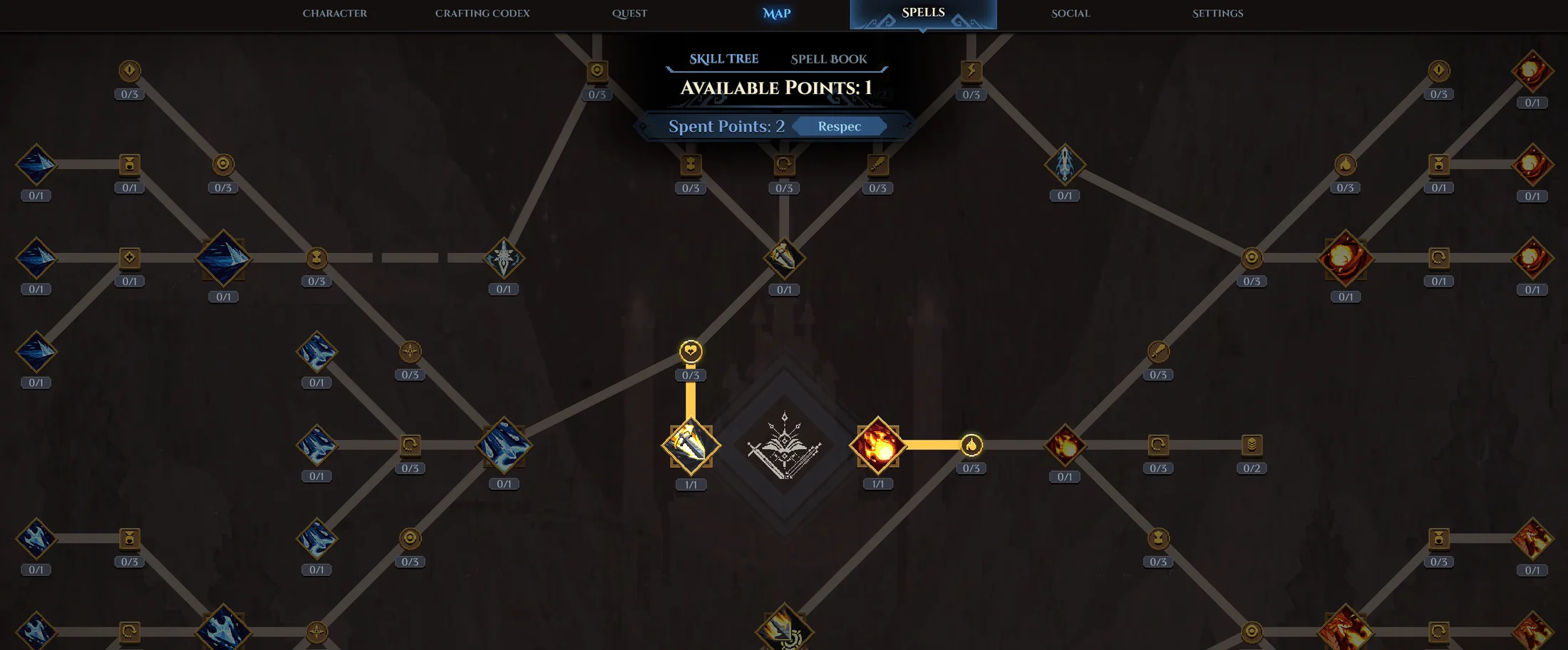
The connected tree illustrates why the route cost matters as much as the destination node.
Fire direction
Fire is named as part of the Magician identity in the recorded character-system material. That supports using fire as one possible direction, but current records do not establish a specific mandatory fire spell, stack cap, set bonus or boss rotation for Elf Mage.
Build a fire direction only after checking three current tooltips:
- The action that applies or creates the relevant fire state.
- The modifier or follow-up that gains from that state.
- The resource and attribute requirements for both.
Compare this with the Human Magician fire build, but do not copy racial weapon assumptions from Human to Elf. The class element may overlap while weapon access, combination passive and connected tree choices differ.
If the fire route handles ordinary enemies but fails on a boss, diagnose the actual limit. It may be resource recovery, cast exposure, target movement or insufficient defense rather than the element itself. Replace the failing job, not the entire character identity.
Frost direction
Frost is also named in the Magician class directions. No complete Elf Mage freeze, chill or ice-scaling formula is currently verified, so this page does not assign stack values or promise crowd control.
Use the same interaction test: identify what the first frost spell visibly does in the current tooltip, identify the payoff, and check whether the route needs a utility modifier that reduces damage or changes the spell's original behavior. One one community discussion about ice reports that some modifiers trade utility for another effect, but it is not sufficient to publish a fixed Elf Mage frost route.
A frost setup can be worthwhile if its visible control or positioning benefit solves a real problem. Do not keep it solely because an element label fits the class fantasy. Compare encounter results with the same character, equipment and difficulty.
Dagger-and-spell hybrid
Elf's twin daggers make a hybrid tempting. The useful version alternates jobs: weapon actions cover recovery, quick pressure or repositioning, while spells deliver an effect or payoff the daggers do not provide alone.
The risky version splits attributes among weapon damage, spell requirements and several resource pools without completing any interaction. Before investing, answer these operational points from the current interface:
| Check | Passing result |
|---|---|
| Spell access | Every chosen spell meets its listed attributes |
| Weapon purpose | Dagger actions restore, position or contribute to the same interaction |
| Resource continuity | A second cycle is possible without waiting through an unsafe gap |
| Tree cost | Connecting nodes still leave room for the core modifier and one defense |
| Encounter fit | The character can operate when staying in melee is unsafe |
If the daggers exist only as an emergency fallback, do not over-invest in their damage. If they are the primary recovery engine, test attack speed and exposure against real enemies rather than a stationary target.
Equipment priorities
No verified Elf Mage best-in-slot set appears in current records. Do not invent a shopping list from set names shown in unrelated Shadow or Minotaur footage.
Evaluate equipment by function:
- It helps meet a required attribute without breaking the rest of the plan.
- It strengthens the core spell interaction under its actual condition.
- It improves the resource or recovery bottleneck.
- It provides enough defense to finish the cast or escape.
- Its set requirement is achievable with the pieces currently available.
The in-game Codex shown in a general demonstration can display discovered set information and where known pieces come from. Use the installed Codex rather than relying on a translated or incomplete item name. If an entry has not been discovered, keep the source or bonus marked unknown.
The Dimraeth crafting guide can help with material and recipe planning, but crafting access does not prove that a particular item is optimal for this build.

Use the live equipment panel to compare current effects; this Lifebloom screen is not an Elf Mage best-in-slot claim.
Defensive layer
A build is not complete when it produces one large hit. It must survive long enough to set up the interaction and recover. Elf's fast weapon identity does not prove invulnerability, and mobility in a creator's subjective assessment is not a substitute for a defensive plan.
Choose at least one protected action:
- A movement option reserved for leaving danger rather than increasing damage.
- A defensive spell or pet effect whose current tooltip can be verified.
- Enough durability to survive the common mistake you are actually making.
- A control or grouping action that creates a safe cast window.
One community reply suggests a defensive pet shield before entering a group, but the evidence does not establish the pet name, unlock route, effect value or current version. Treat the pattern—use protection before committing—as advice, not the pet details as a verified requirement.
Early progression checkpoints
Functional first loop
The first checkpoint is not a level number. It is the moment the opener, payoff and recovery work together with current tooltips. Avoid spending toward several distant branches before this loop functions.
Attribute gate
The second checkpoint is the highest requirement among the next spells you intend to equip. Train for an actual requirement, not a guessed final stat spread.
Defensive correction
The third checkpoint is a response to the first repeated failure. If casts are interrupted, add protection or timing. If resources run dry, fix recovery. If a boss moves out of the effect, improve setup or choose a different payoff.
Equipment reinforcement
Only after the loop survives should equipment chase amplify it. A set bonus cannot rescue a rotation whose spells cannot be equipped or repeated.
Combat sequence
Use a descriptive sequence rather than a rigid named rotation:
- Approach at a range where the opener can land without consuming the escape tool.
- Apply the verified state or grouping effect.
- Use the payoff while the condition is active.
- Return to dagger attacks or the chosen recovery action only when it is safe.
- Reposition before repeating instead of forcing the second cycle through an enemy attack.
This sequence is intentionally adaptable. The evidence does not support frame timings, a permanent hotbar or a universal boss rotation for Elf Mage.
Troubleshooting the Elf Mage build
| Symptom | First check | Next adjustment |
|---|---|---|
| A spell cannot be equipped | Read its current attribute requirements | Train only the missing requirement before adding scaling |
| The first cast works but the loop stops | Identify the depleted resource | Add a verified recovery action or remove the extra spender |
| Daggers feel unrelated | Define their job in the loop | Use them for recovery or repositioning, or reduce weapon investment |
| Tree points disappear without payoff | Count connecting nodes | Stop at a nearer complete interaction |
| Damage is good but casts are interrupted | Check exposure and movement timing | Reserve a defensive or control slot |
| A community build cannot be copied | Check race, class, build and tooltip version | Transfer the interaction principle, not unverified names |
| Gear change breaks the setup | Compare requirements and active set count | Restore the functional baseline before testing another piece |
Build verification sheet
Before calling the character finished, record the evidence visible in your current build:
- Race and class: Elf and Magician.
- Racial weapon shown by the game.
- Equipped spells and their attribute requirements.
- Resource used by each active action.
- Core applied state and the action that benefits from it.
- Connected skill-tree path and total spent points.
- Equipment bonuses that are currently active, not merely planned.
- One defensive or movement option.
- The encounter and difficulty used for the test.
Run the same short encounter several times. A build that wins once because an enemy failed to pressure the character is not yet reliable. Compare recovery, safety and repeatability, not only the largest number on screen.
Current recommendation
Start the Elf Mage as a focused Magician with an Elf weapon context, not as a collection of every attractive magic and dagger option. Choose fire or frost as the first test direction, meet the chosen spell requirements, complete one connected interaction and preserve a way to recover and escape.
No tested record is strong enough to establish a fixed end-game allocation, item set or pet as the definitive Elf Mage build. The planning method remains useful because every decision can be checked against the installed tooltip, current tree and actual combat result instead of depending on an unsupported preset.