
Restore Concentration during combat by landing basic attacks. Recovery potions provide another resource tool when available and prepared. Swinging without hitting does not satisfy the basic-attack condition, and a spell dealing physical damage is not automatically a basic attack.
If you repeatedly run out, inspect the sequence between casts. You need an opening in which the recovery attacks can connect, followed by enough resource for the action you intend to use. More spell icons on the bar will not fix a sequence that never lands a recovery hit.
Dimraeth Concentration recovery loop
- Stop pressing a spell you can no longer afford.
- Move to a position from which your ordinary attack can hit safely.
- Land basic attacks during an opening and watch the resource indicator.
- Use the spell that serves the next step of the fight.
- Reposition and repeat when needed, rather than spending every opening on casting alone.
This is a combat rhythm, not a fixed number of required hits. The available material does not establish a universal amount restored per hit. Build-specific modifiers and the cost of the next spell can also affect how many attacks are useful before casting again.
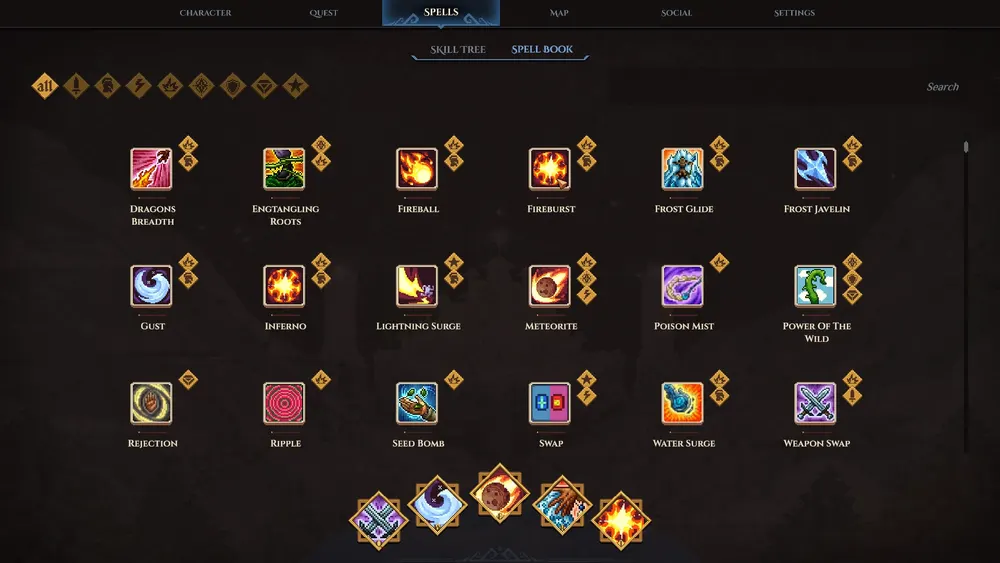
The spell collection and five active positions illustrate the actions competing for your casting resources. A full active bar does not mean the character can afford every action in sequence.
Basic attacks and physical spells
“Hit an enemy with a basic attack” is more precise than “deal physical damage.” A damaging skill may look like a weapon attack while still being an active spell with its own cost. Read the action and test the resource feedback instead of relying on the animation alone.
This distinction matters when a player spends Concentration on a physical skill hoping that its damage will refill the bar. If the recovery condition asks for an ordinary attack, that substitution can leave the character with less resource than before.
The third basic hit counts as a Final Attack for relevant interactions. That can make the chain important to a build, but do not force its completion when the enemy is about to strike. A safe shorter opening is better than taking a hit solely to reach a trigger.
Human Weapon Swap resource checks
Human's sword-and-crossbow arrangement offers different basic-attack positions. Check Weapon Swap’s current tooltip to identify any cost and the resource it uses. Its exact resource requirement is not verified here; do not assume it draws on the same pool as the spell you want to cast.
Choose the form that suits the opening, then use it to land the attacks you need. Constantly changing forms can consume part of the resource you just recovered. It is a tool for positioning and attack choice, not a free refill button.
For the racial differences behind that choice, read the Dimraeth races guide. A caster's class label does not remove the racial attack rhythm used between spells.
Concentration potions and preparation
Recovery consumables offer another way to support casting. Prepare the intended combat-item slot before the encounter and check the charges. Having an item somewhere in the bag is different from being ready to use it under pressure.
Resting can refill combat-item charges in the demonstrated rest system. Manufacturing a fresh base potion, upgrading an existing potion and replenishing its charges are separate tasks. If the item is already owned but empty, inspect the rest and charge state before making another copy.
The Dimraeth recipes guide explains those distinctions. No exact current Concentration-potion recipe, recovery amount or cooldown is asserted here; use the description of the item in your installed version.
Co-op examples also discuss resource support through consumables. Coordinate who uses what and when rather than assuming a teammate will automatically supply the recovery missing from your own sequence.
Capacity and recovery are different
Memory is associated with Concentration capacity in the character material. A larger pool and a better recovery sequence solve different problems. More capacity can allow a longer opening sequence, but it does not make missed basic attacks satisfy the recovery condition.
Before spending attributes, identify which problem you have. If the next spell is unaffordable even at your intended starting resource, inspect its cost and requirements. If the bar empties during a prolonged fight, inspect how you recover between casts.
There are also build-specific recovery-node discussions, but no universal per-hit bonus is established here. Do not take a number mentioned beside an unidentified node and apply it to every character.
Concentration troubleshooting
| Symptom | Likely check |
|---|---|
| Attacks animate but the bar does not improve | Confirm the basic attacks connect with an enemy |
| A weapon-looking skill makes the problem worse | Check whether it is a paid active action rather than a basic attack |
| Human switching leaves too little resource | Reduce unnecessary Weapon Swap use |
| The intended spell never appears on the bar | Check learning and assignment, not recovery |
| One skill fails despite available Concentration | Inspect its other costs, charges and input behaviour |
| The potion is owned but unavailable | Check prepared slot, charges and combat-state restrictions |
The Dimraeth spell-equipping guide handles acquisition and input failures. A missing spell, an unmet learning requirement and an empty resource bar can look similar during a stressful fight, but they require different fixes.