
Dimraeth's basic weapon style is tied to race. Human uses a sword-and-crossbow kit with Weapon Swap; Minotaur has a heavy melee identity; Elf is shown with dual daggers. Choosing a different class changes the class and archetype contributions, but it does not automatically replace that racial weapon identity.
This is a rule about the basic kit. It should not be expanded into an unsupported claim that every equipment slot is permanently fixed, that no weapon-related effect can ever change or that all dropped equipment is unusable. Basic attacks, active spells and equipment bonuses are different parts of the character.
Dimraeth racial weapons and class choices
| Example | Basic-kit observation | What it establishes |
|---|---|---|
| Human Brawler | Sword and crossbow switching | Weapon Swap is not exclusive to Shadow |
| Human Shadow | The same racial switching identity | A class change is not required to explain the two weapon forms |
| Human Magician | Human weapons alongside caster spells | Choosing Mage does not remove the racial weapon kit |
| Elf Mage | Daggers alongside Fireball and Blizzard | Spellcasting class and basic weapon style coexist |
| Minotaur Brawler | Deliberate melee attacks with later skill options | New active skills can change combat flow without proving a new base weapon category |
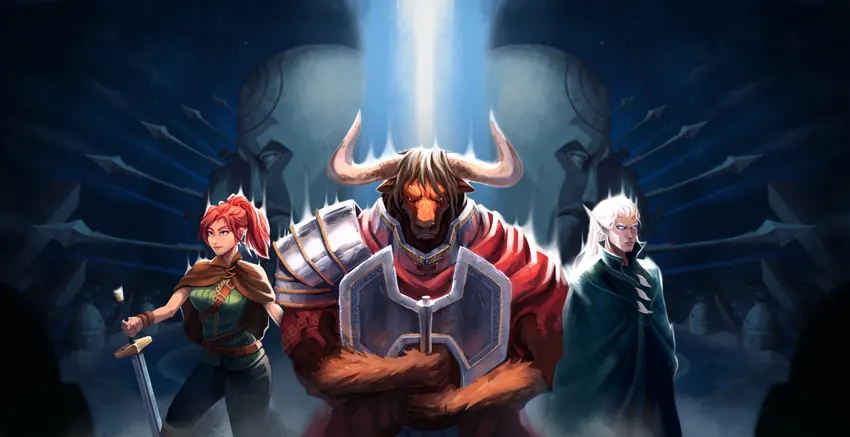
The three racial silhouettes illustrate distinct basic combat identities. Artwork alone does not establish equipment-slot restrictions or an exhaustive weapon list.
Compare characters of the same race before attributing a weapon difference to class. Human Brawler and Human Shadow provide a particularly useful correction to the idea that only a rogue-like class receives Weapon Swap. The Dimraeth races guide puts those examples alongside the broader racial choice.
Human Weapon Swap is an active decision
Weapon Swap changes between the Human kit's sword and crossbow forms. It is not a general instruction to equip any weapon found in a chest. Its usefulness comes from choosing the form that suits the next part of the fight.
A close opening may suit one attack pattern, while another position may call for the other form. Make the choice deliberately: check the current Weapon Swap tooltip for any resource cost. Its exact resource requirement is not verified here, so do not assume it draws on the same pool as another action.
If the switch is not on the button you expect, inspect the current active loadout and binding. A controller example places Weapon Swap on a rebound combination, so memorising that input as a universal default would be misleading. Follow the prompt attached to your own slot.
The Dimraeth spell-equipping guide explains slot assignment and input checks. Use those checks before concluding that the racial ability disappeared after you changed another spell.
Mage does not remove ordinary weapon attacks
A caster still has a basic attack kit. During combat, landing basic attacks restores Concentration, which gives the weapon rhythm a practical role even when most of the build's interesting effects come from spells.
For a Human Mage, the sword-and-crossbow decision can affect where those recovery attacks happen. For an Elf Mage, the dagger example asks for a different spacing plan. The class name alone does not describe that difference.
Do not replace the recovery requirement with “deal physical damage.” A physical-damage spell is not automatically the basic attack used by the recovery loop. Check the action you are actually pressing and whether it connects with a target.
If a caster feels unable to sustain spells, inspect the weapon-hit and casting sequence before blaming the race. Missing attacks, unnecessary switching and spending the recovered resource immediately can all make an otherwise understandable kit feel unreliable.
Weapon appearance, damage conversion and spell effects
A skill can change what an attack does without establishing that the character equipped a different weapon category. The Minotaur Brawler Blunt-conversion example is about the damage behaviour of basic attacks and its interaction with stun buildup.
That conversion should not be treated as evidence that every Minotaur has the same modifier from creation. It belongs to a particular build interaction with prerequisites. Likewise, a fiery active attack does not prove the racial weapon has permanently become a fire weapon.
World spellbooks add another layer. A character can learn a spell outside its native tree when it meets the requirements. Seeing a Minotaur use a fire-related book therefore does not contradict the racial basic-kit rule.
For planning, keep four questions separate: which action is the basic attack, which spell occupies the slot, which modifier changes its behaviour and which equipment effect triggers during combat. The race, class and archetype tree guide explains how those sources fit together.
Equipment changes can still matter
Equipment can contribute statistics, set requirements and triggered effects even when it does not replace the racial attack style. Compare an item in that context rather than dismissing all equipment because the basic kit is racial.
Before replacing a piece, inspect any active set effect that depends on it. A build can lose an effect after a swap even though the new item has a stronger individual statistic. The resulting change is an equipment interaction, not proof that the race changed its weapon rules.
Dismantling and reinforcement are also distinct from creating a new weapon from raw materials. Do not infer a full equipment-crafting system merely because an anvil lets you improve something already owned. The Dimraeth recipes guide separates those operations.
Trying another weapon identity
If the racial attack rhythm does not suit you, comparing another race with a separate character is a direct way to try a different basic kit. Hold the class constant if possible so you can recognise which differences come from race.
Do not assume a skill reset changes race or class. The existence of a respec service does not establish the scope of what it refunds, and creating another hero in an existing world is not the same as transforming the original hero.
The practical choice at creation is to select a basic kit you are comfortable using between spells. Later skills can add mobility, effects and new decisions, but they should not be used as an excuse to promise an unverified replacement system for the racial weapon style.