
No verified current table of Dimraeth rune set spell bonuses is available in the reviewed documentation. The only concrete recorded threshold is a three-piece Lifebloom example that adds health to that character; it does not prove a spell bonus, a Rune Set catalogue or a universal best package. Use the live equipment panel to verify current effects instead of converting one example into invented bonuses.
Available records confirm that equipment has named set affiliations and that active thresholds can change the overall loadout. A recorded early character keeps a three-piece Lifebloom package for its displayed health benefit instead of breaking it for one movement-speed item. That is a version-scoped example, not proof of any spell-focused rune bonus and not a universal recommendation to use Lifebloom.
Dimraeth rune set evidence check
- Write down the set name on every equipped piece.
- Read each active threshold and record only the effect printed in the live tooltip.
- Describe the combat loop the current set supports.
- Unequip nothing until the proposed replacement package is assembled in storage.
- Compare the current and proposed states, including bonuses that disappear.
- Test one controlled combat route with the old package and one with the new.
- Keep the package that performs the required jobs more reliably.
Rarity, item level and a single affix are inputs to this comparison, not the conclusion. The active effect can be the reason several otherwise modest pieces belong together.
Set pieces and build layers
A documented character overview describes Dimraeth builds as the result of race, class, stats, skill tree, spellbooks, equipment, set bonuses, upgrades and pets. Gear completes the build rather than replacing every earlier choice. It also describes equipment drops as having rarity, random affixes, prefixes, stats and named set affiliation.
That layered model prevents a common mistake: treating a set bonus as though it grants access to every surrounding skill-tree modifier. A piece may enhance an action, add a trigger or improve a damage pattern, but the character still needs the appropriate learned spell, active assignment and supporting resources.
Use the Dimraeth skill-tree guide to separate shared spell access from race–class-specific nodes. Use the spell-equipping guide when an owned spell is not appearing in the active loadout.

The equipment panel is the place to compare named affiliations, affixes and active thresholds. Judge the state before and after a swap.
Active threshold comes first
Read the set counter and bonus text on the equipped state. Record which thresholds are active now and which are merely listed for later. A three-piece bonus does not require pretending that the six-piece effect is already functioning. Likewise, one excellent piece from another set is not a two- or three-piece package by itself.
Use a table for the proposed change:
| Comparison | Current package | Proposed package |
|---|---|---|
| Equipped set pieces | Count shown now | Count after the swap |
| Active thresholds | Effects currently enabled | Effects enabled after replacement |
| Supported spell or action | Actual loadout job | New loadout job |
| Lost stats and effects | None before change | Every removed benefit |
| New stats and effects | Current total | Every added benefit |
| Missing pieces | Not relevant | Pieces still required |
Do not compare the right column as though missing pieces have already dropped. The transition state is what the character must play today.
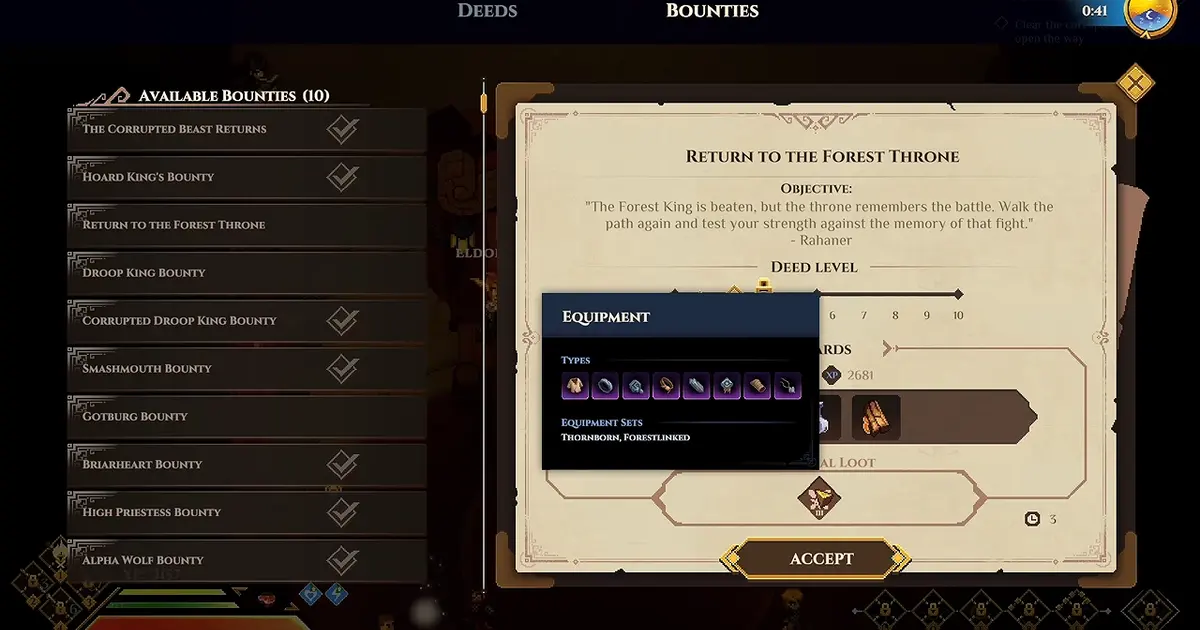
Reward tooltips can identify a candidate set piece, but only the equipped panel confirms which threshold remains active after a swap.
Lifebloom as an early example
In recorded gameplay, a creator keeps three Lifebloom pieces because the displayed set bonus adds 30 health to that recorded character. They reject one replacement offering movement speed because, for that particular early route, the functioning package is more useful. The footage later says the early chapters can be completed while retaining a Lifebloom rune, shirt and sash.
This example teaches a method, not a build command. Another character may value movement, damage, defence or resource support differently. The exact item names, value and early-route judgement are tied to the video and build. Do not extrapolate the 30-health figure to another tier, patch or set.
The transferable rule is to calculate what disappears. If removing one Lifebloom piece drops the counter below its active threshold, the comparison is not “old item versus new item.” It is “old item plus active set effect versus new item plus the reduced set state.”
Spell fit and set fit
A set bonus has value only when the build can trigger and use it. Start from the combat loop. A recorded builds guide recommends deciding what one successful loop should accomplish before spending heavily on gear. It gives examples of layering status effects, triggering supporting passives, recovering Concentration and spending it on the next meaningful cast.
For your build, write the jobs in plain language:
- establish the required status or opening;
- use the spell or attack that consumes the opening;
- recover the resource needed for the next cycle;
- survive while effects or cooldowns run;
- repeat without relying on an unavailable action.
Then place the set effect beside the job it supports. If it has no clear job, it may be attractive but nonessential. If it changes the spell that begins the whole sequence, breaking the threshold can collapse more than the tooltip's raw number suggests.
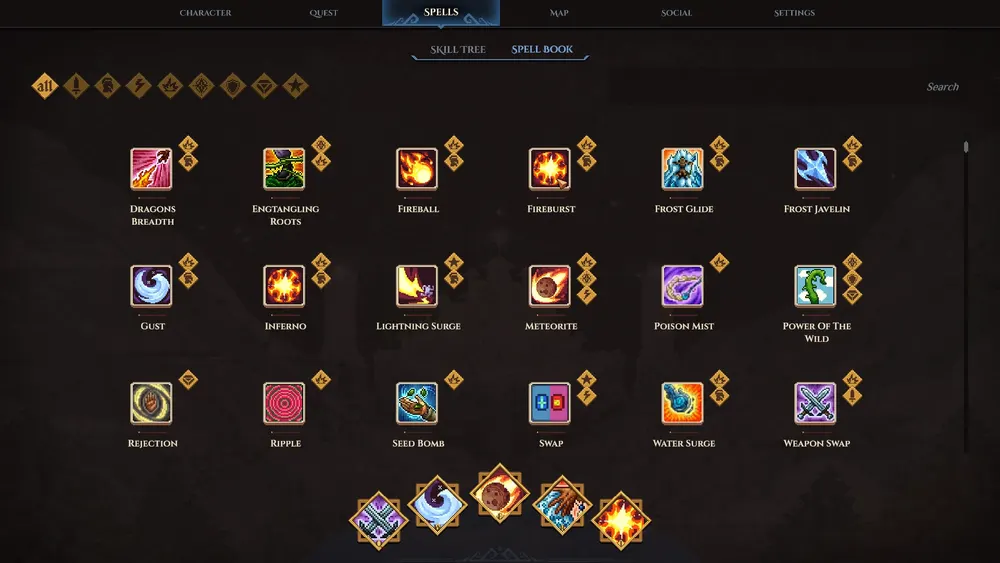
Compare a set effect with the spells actually learned and assigned, not with an unavailable name in a loot list.
Learned spells and gear effects
The available spell reference lists many spells across multiple elemental schools. Owning a set piece does not prove the associated spell has been learned, meets its attributes or is assigned. Check the spell collection and active bar before farming or equipping a package built around a name you cannot currently use.
Separate four states:
- the spell recipe is discovered;
- the spellbook is crafted or obtained;
- the character meets the learning requirement and learns it;
- the spell is assigned and usable in the active sequence.
A rune set can modify the fourth state only when the preceding requirements are satisfied, unless the live tooltip explicitly says the gear itself grants a separate proc. The supplied excerpts do not provide a complete current catalogue of gear-granted procs, so this page does not invent one.
Affixes, rarity and named affiliation
Equipment drops can carry rarity, affixes, prefixes, stats and named set affiliation. These axes can point in different directions. A rare item may have individually strong stats but belong to no set used by the current build. A lower-looking named piece may be necessary to keep a threshold active. A matching piece can still have affixes that contribute little.
Use three passes:
- Package pass: does the piece activate or preserve the intended set effect?
- Stat pass: do its flat and percentage stats support the character now?
- Operation pass: does the resulting loadout remain playable and resource-stable?
Only after all three should an upgrade be funded. Upgrading first and deciding later spends materials on an uncertain role.
Mixing sets deliberately
The documented character overview explicitly introduces mixing sets instead of automatically completing one. The correct mixed package is not “as many names as possible.” It is a deliberate combination of thresholds whose effects can all operate in the same build.
Compare a completed early threshold from one set with the partial progress toward a later threshold from another. Two active smaller effects can be better than wearing five pieces toward a six-piece bonus that is still inactive. Conversely, a single higher threshold can be stronger when it changes the core spell the entire rotation uses.
Avoid promising a universal best ratio. The evidence does not provide all set names, every threshold or current values. Read the live tooltip and choose based on the jobs your build needs.
Transitioning to a new set
Keep the old pieces in storage while collecting the replacement. Do not salvage the working package after the first new drop. Build a complete transition set, then test it as a unit. This avoids spending several sessions in a weak middle state where neither package reaches its intended threshold.
A safe transition sequence is:
- mark the old set as protected;
- collect the target slots without equipping them immediately;
- compare affixes and upgrade costs;
- confirm the new threshold is reachable now;
- equip the full proposed package in a safe area;
- verify active set text and spell assignment;
- run a familiar encounter;
- revert if the loop loses reliability.
Storage is part of build design. The Pinewood Planks guide explains the early workbench bottleneck that leads into player-built storage.
Upgrade and salvage timing
Creator footage shows a town forge flow that salvages unwanted equipment into materials and upgrades retained pieces, with additional stats appearing during investment. The exact cost and random outcomes shown belong to that character and patch. The decision order remains useful: keep the working package, salvage clear rejects, then upgrade selected pieces.
Do not salvage duplicates automatically. A duplicate set affiliation can fill a different slot, support another character or preserve a threshold while a better-affixed replacement is evaluated. Sort first, destroy later.
When upgrading, stop at a planned checkpoint and re-read the complete state. A new random stat does not automatically make the piece compatible with a different damage type or spell loop.
Rune set farming
Named equipment can come through normal drops and repeatable content. Elite boss material in the available documentation links unique sets with Deeds, and a current player report says some set slots can come from normal enemies on higher-difficulty mainline boss routes.
Use the elite equipment drop guide to choose the route, level and source layer. Write down the missing slot before farming. Do not repeat a boss only because the set name sounds connected; confirm Potential Loot or a current observed source.
There is no verified universal drop rate or pity counter in the available documentation. Track results without converting a short personal sample into a published percentage.
Controlled testing
Choose an encounter the current build understands well. Run it with the old package and record survival, resource stability, time to complete the combat loop and mistakes caused by the loadout. Then equip the complete proposed package and repeat under the same difficulty.
Do not change skill points, spell order, difficulty and gear simultaneously. If the result improves, you need to know which change caused it. A set test should be about the set.
Useful observations include:
| Observation | Meaning |
|---|---|
| Core spell is stronger but recovery collapses | The set improves output but the loop lacks resource support |
| Damage rises while survival becomes unreliable | The package trades consistency for offence |
| Tooltip improves but encounter time does not | The bonus may not affect the actions used most often |
| New effect rarely triggers | Trigger condition may not fit the build's normal sequence |
| Old package remains faster | Active threshold may outweigh isolated new stats |
Several runs are better than one lucky or unlucky performance.
Co-op considerations
In co-op, a support or control effect can have value not captured by solo damage time. Record what the set contributes to the group: creating an opening, sustaining the caster, protecting an ally or applying a shared status. Do not evaluate every package only by the final damage number.
At the same time, do not assume another player will always supply a missing job. A personal farming setup should remain functional when the expected teammate is absent. Store a solo-stable alternative if the co-op package depends on a coordinated group.
The supplied excerpts do not establish exact stacking rules for identical set effects across players. Test visible behaviour rather than promising additive or multiplicative stacking.
Early Access version checks
Set values, thresholds, spell interactions and item availability can change during Early Access. The evidence combines a current guide, creator footage and reference pages without a single shared build identifier. Treat exact recorded values as snapshots.
When a tooltip differs, use the installed version and note the discrepancy. Do not overwrite a current effect with an older quoted number. When a set no longer changes the same spell, rebuild the comparison around the new text instead of forcing an obsolete rotation.
Unsupported conclusions to avoid
This page does not claim a complete set list, a universal best set, fixed drop rates, or a guaranteed six-piece goal. It does not claim every named set grants an active spell. A third-party snippet is not proof of a specific proc.
It also does not recommend copying the recorded Minotaur early route to every race and class. That video's Strength, health and Lifebloom choices belong to its character. Use the comparison method while respecting the actions and resources of your own combination.
Final rune-set decision
Keep the current package when its active threshold supports a necessary job and the replacement remains incomplete. Change when the new package is assembled, its effects fit the active spells, and controlled testing shows a real improvement. Store meaningful alternatives until the transition is proven.
The useful question is not “which single item is rarer?” It is “which complete equipped state lets this character perform the intended combat loop reliably?” Answer that, and Dimraeth rune set spell bonuses become a planning tool instead of a source of accidental downgrades.