
Choose Moon Cat when your spells keep stopping because you need Concentration, Carrion Parrot when your character already applies Bleeding, Ember Hound for Fire Damage and Burning support, or Fangra Cub for a mixed attack that adds Strike Damage, Bleeding and Chill. The best ability depends on the part of your combat loop that needs help. A companion that solves that problem can be more useful than one that merely adds another damage effect.
These recommendations compare four named companions by their abilities. They do not establish a damage ranking for every pet or promise that one choice wins on every character. If you have not opened the companion system or need to equip a pet, follow the separate pet unlock and equipment guide before comparing their combat roles.
Match the ability to the problem
Start with what interrupts your own character. If you spend more time waiting for spell resources than attacking, an additional source of damage may leave the real problem untouched. If your attacks already build Bleeding reliably, a companion that reacts to that condition has a clear job. If your skills care about Burning, a Fire companion offers a more direct match than a pet whose main effect belongs to another damage package.
| Companion | Main ability contribution | Strong reason to choose it | Important condition |
|---|---|---|---|
| Moon Cat | Astral Purr restores Concentration over two seconds | Repeated spellcasting needs more resource support | Extra Concentration must actually enable a useful cast |
| Carrion Parrot | Carrion Sweep adds Bleeding to a bleeding target and a nearby enemy | Your character already creates Bleeding | An enemy must already be Bleeding for the described trigger |
| Ember Hound | A dash leaves a Fire pit, dealing Fire Damage and applying Burning | Fire and Burning are already part of your plan | Check whether those effects help your own skills |
| Fangra Cub | Savage Leap combines Strike Damage, Bleeding and Chill | You want several offensive effects from one companion | Mixed effects do not automatically mean highest damage |
A useful comparison keeps the character fixed. Changing your spells, equipment and companion together makes it hard to know which change improved the fight. Pick the companion after you understand the job of the rest of your build, then adjust one part at a time.
Moon Cat supports repeated spellcasting
Astral Purr restores Concentration over two seconds while the Moon Cat remains near the player. This makes its contribution different from another direct attack: the benefit appears when that recovered resource lets you continue a spell sequence that would otherwise stop.

Moon Cat deserves an early place in the comparison if your character has enough damage when its spells are available but struggles to maintain that output. A larger collection of damaging abilities does little when you cannot afford to cast them. Resource support can help an existing sequence work more consistently without asking you to add another status type.
That does not make Moon Cat a replacement for your recovery routine. You still need to understand how much Concentration your chosen abilities cost and whether you are landing the basic attacks that support casting in combat. The Concentration recovery guide covers that loop; the companion decision here is whether Astral Purr improves it enough to justify the slot.
Evaluate the effect during the sequence you actually use. Notice whether a cast becomes available sooner, whether you can complete another part of the sequence, and whether the same resource problem keeps returning. If the spell still cannot be used because its learning requirements are unmet, changing pets will not solve that separate issue. If Stamina is the resource preventing a hybrid ability from being cast, Concentration recovery alone may also leave the interruption in place.
Pet levels matter when comparing support. Moon Cat's recovery can improve as the companion develops, so the ability on a newly selected pet should not be treated as the final performance of that species. Read the ability and current pet level together rather than copying a fixed recovery amount from another character.
Carrion Parrot extends an established Bleed plan
Carrion Sweep watches for a Bleeding enemy. It adds one additional Bleeding stack to that target and two stacks to one nearby enemy. The starting condition is the important part: this ability builds on Bleeding that is already present.
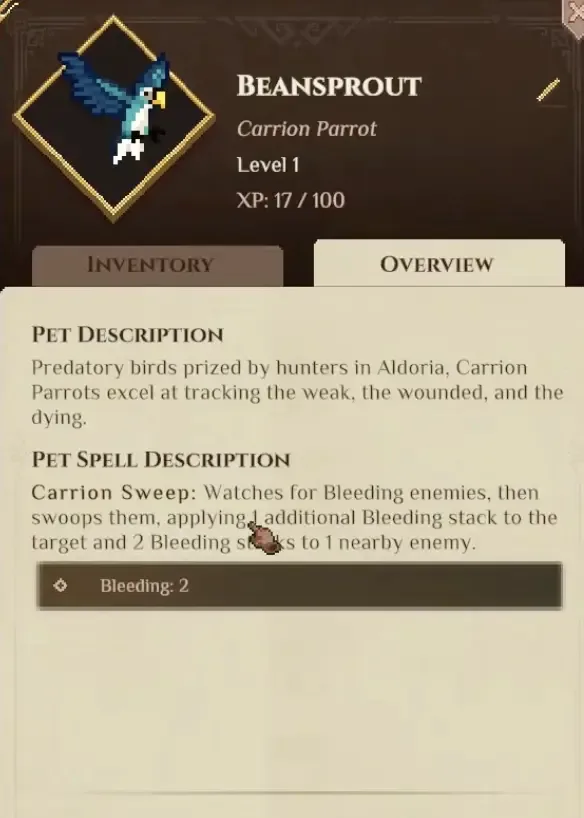
Choose Carrion Parrot when your character can create that condition as part of its normal attacks or abilities. You then have a clear sequence: your character starts Bleeding, and the companion extends the pressure. That makes the bird especially relevant to a build whose skills and equipment already care about the same effect.
Do not treat the parrot as the sole explanation for a Bleed build. Its reactive contribution is only one part of the loop. If you equip it on a character that rarely puts Bleeding on an enemy, the named trigger has fewer opportunities to help. Fixing that by rebuilding your whole character may cost more than simply choosing a companion that matches what you already do.
The nearby-enemy portion changes what to look for during a comparison. A single-target check shows the extra stack on the primary target, while a fight with nearby enemies gives the second part of the ability a chance to matter. Compare the same kind of encounter when judging one companion against another. A pet that helps against a pack can feel different in a fight where only one enemy is available.
For a character already following a Minotaur Brawler Bleed direction, the question is whether Carrion Sweep strengthens the existing Bleeding loop. The full skill and attribute route belongs to that build page. Here, the decision stays with the companion's condition and the value of additional Bleeding.
Ember Hound adds Fire Damage and Burning
Ember Hound dashes through enemies in a short line and leaves a Fire pit at its destination. The ability contributes Fire Damage and applies Burning, giving a Fire character a companion whose offensive effects match its chosen direction.
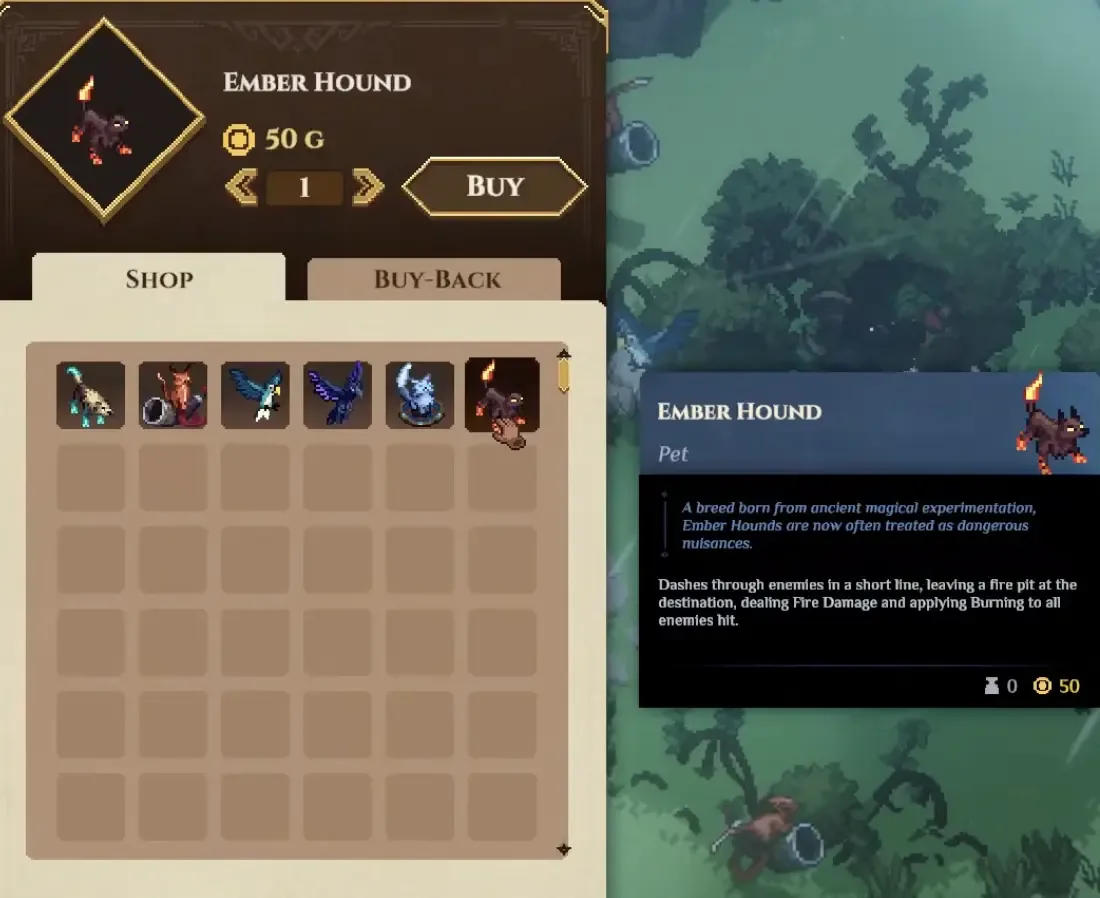
This is a useful option when your own abilities already interact with Burning. Instead of adding an unrelated effect just because it looks impressive, inspect whether the Fire and Burning contribution fits the spells, modifiers and equipment you are using. A shared effect gives you a concrete reason to choose the hound.
The dash and the pit also mean that the attack is more than a damage number in a menu. When comparing companions, watch where the Fire pit appears and whether enemies remain in the part of the encounter where that effect can contribute. Avoid declaring the pet weak or strong from one attack in a situation that never gave its effect a useful target.
A Fire companion is not automatically the right choice for every Magician. A caster whose main difficulty is paying for spells may gain more from Moon Cat. A character dedicated to Bleeding may prefer Carrion Parrot even when the hound produces a more noticeable visual attack. The class label does not decide the companion; the character's current loop does.
If Burning is central to your Human Mage Fire build, compare Ember Hound against the resource support you would give up by using it. That is the actual tradeoff: more contribution to the offensive effect, or more support for casting the abilities that produce it. There is no need to change your whole build merely to justify a pet you have just acquired.
Fangra Cub combines direct damage and two effects
Savage Leap attacks the nearest enemy and combines Strike Damage, Bleeding and Chill. Fangra Cub is a practical broad offensive choice when several of those contributions are useful and you have not narrowed the character around one specific companion interaction.

The mixed profile is its clearest distinction. Carrion Parrot has a specific Bleeding condition, while Moon Cat supports a resource. Fangra Cub brings damage and effects in one attack, making it easy to see why it can contribute before the rest of the character becomes highly specialized.
Separate those effects when assessing the result. Extra Bleeding may suit a character already working with that status, while Chill adds another effect to inspect. Neither one proves that the pet is the best damage choice for every encounter. Multiple entries in a tooltip describe what the ability does; they are not a score that can be compared directly with a resource ability.
Nearest-enemy targeting also matters to your expectations. Do not assume a different target-selection command or a precise control option that the ability does not describe. Watch which enemy receives the leap and whether that is the target your character currently needs help against. This keeps the comparison tied to the actual ability instead of an imagined version of it.
A pet's custom name is not its species. A Fangra Cub may have a name different from the one shown on another character's screen. Compare the species, ability and level so that a renamed companion does not appear to be a separate pet with a different role.
Compare companions without changing the whole build
Use a short, repeatable comparison when you already own more than one suitable pet:
- Keep your race, class, equipped skills and gear the same.
- Choose the problem you want the companion to improve: casting resources, Bleeding, Fire support or broader offensive contribution.
- Read each candidate's ability and current level.
- Use the same type of fight so that group effects and single-target effects face comparable conditions.
- Watch for the named trigger, resource gain or status contribution rather than judging only the visual animation.
- Keep the companion that improves the problem you selected, then reassess after your build or pet levels change.
An underdeveloped pet and a more developed pet can give a misleading first comparison. If the new companion has an ability you want but currently contributes less, check its level before deciding that the species is a poor fit. Conversely, a companion you have invested in does not have to remain selected forever if your character's needs change.
Do not use an assumed universal pet cap to make that choice. Read the current companion panel. Early Access can change progression and balance, and one pet's displayed limit does not establish the permanent limit of every species. Your immediate decision is whether the ability and its current development help your character, not whether another player's exact numbers must match yours.
Keep combat choice separate from collection
Selecting a combat companion and collecting every pet are different tasks. A new unlock gives you another option; it does not by itself prove that you should replace a companion already supporting your character. Collection routes, Myrll access and Pet Pen problems remain in the companion system guide.
For combat, use the simplest supported match: Moon Cat for needed Concentration, Carrion Parrot for an existing Bleed engine, Ember Hound for Fire and Burning, or Fangra Cub for mixed offensive effects. Revisit the choice when your skills change the resource or status that matters most. That keeps the pet connected to a real combat need instead of turning every new companion into an automatic upgrade.