
Dimraeth's documented Early Access class selection does not include a dedicated Summoner. The available classes are Magician, also called Mage, Brawler and Shadow. Some later abilities can produce temporary summons, and summon spellbooks belong to the wider ability system, but that does not establish a complete minion-only build from the beginning of the game.
If your goal is to let summoned creatures do essentially all the fighting, that route remains unconfirmed. If you want a normal combat character that also uses a temporary summon or a companion, those are different and more limited goals. Choose between them before committing attributes or assuming that a class name promises the playstyle you want.
A summon ability is different from a Summoner class
A class gives your character its starting layer of abilities and skill-tree direction. A spell found in the world can add an ability outside that starting kit. Summons are included among the wider spellbook options, alongside support and utility abilities, and world spellbooks can be learned by different race/class combinations when their requirements are met.
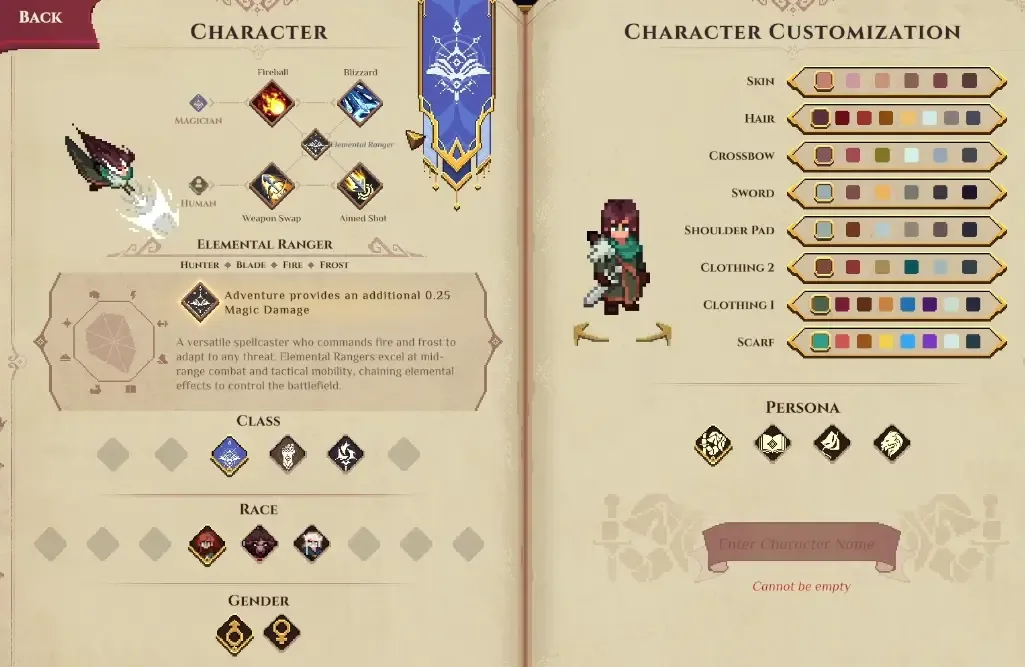
A Human Magician creation panel illustrates the class and race pairing; it does not show a Summoner class.
This means the presence of a summoned effect does not create a fourth Early Access class. It also means that selecting Magician is not a guarantee of an immediately available minion build. The exact ability you can obtain, learn and equip matters more than the assumption that a magical class must contain the summon you want.
Do not choose a character on the expectation of an unreleased Summoner option. A future class plan is not an available character selection, and it does not provide a present-day skill tree or a working progression route.
Temporary summons and persistent pets have different roles
A temporary summon is produced by an ability. Its practical value depends on that ability's actual conditions: what it creates, how long the effect lasts, what using it costs, and when you can use it again. Do not infer those properties from a familiar summon system in another RPG.
A pet is a companion with its own ability and progression. For example, Moon Cat provides Concentration support, while Fangra Cub contributes an attack with Strike Damage, Bleeding and Chill. Equipping a combat pet can add support to your character; it does not establish that the character can stop attacking or casting altogether.
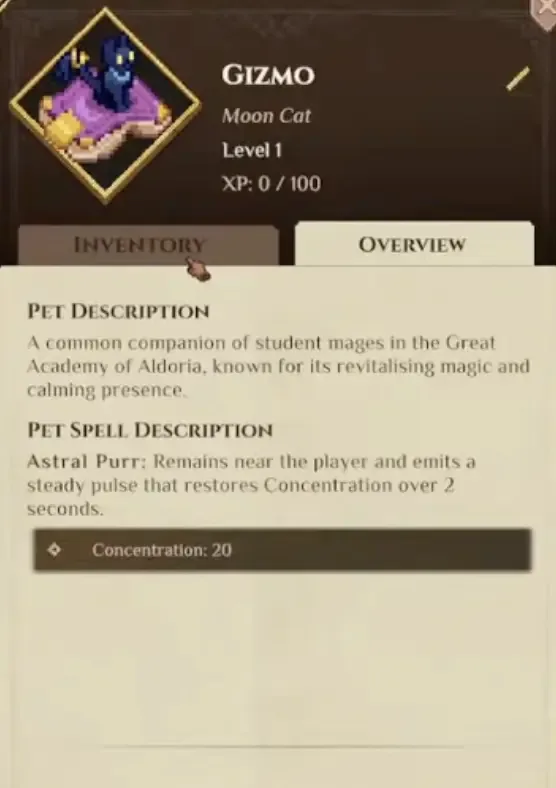
Moon Cat is a persistent companion with Astral Purr, separate from temporary summon spells.
Keep those systems separate when deciding what kind of summoning play you want. A companion-focused character still needs to account for the abilities and actions performed by the player. A skill that briefly creates a summoned effect may suit a hybrid build without becoming its entire damage engine.
Companion unlocking and equipment belong to the pet system guide. The pet ability comparison helps choose their combat contribution. Neither page should be read as a validated pure-summoner progression guide.
Inspect an actual summon before planning around it
Before training specifically for a summon, find the ability's real description and inspect its learning requirements. The existence of summon spells in the general system does not identify a guaranteed early unlock, a named spell you already own, or an attribute allocation that will fit every summoned effect.
Check these points on the ability you can actually access:
- The attributes needed to learn it.
- The resource cost of using it.
- Any listed cooldown, duration or condition.
- What the summoned effect is described as doing.
- Whether your character can maintain its normal combat while that effect is unavailable.
If a field is absent or unclear, leave it unresolved rather than substituting a number from another skill. A learned ability and an affordable, repeatable combat loop are separate achievements. You need the latter before relying on the summon as the main reason for the build.
Use the spellbook acquisition guide for finding abilities and the spell equipping guide for assigning one you have learned. Those steps do not prove a minion-only build; they establish that the specific ability is available to your character.
Keep a player-controlled resource plan
Concentration recovery in combat is tied to landing basic attacks. That matters when imagining a character that never fights directly. A temporary summon does not automatically remove the resource conditions of the spell system, and no confirmed minion-only loop here replaces that requirement.
Until an actual ability demonstrates otherwise, retain a basic attack and resource routine that works without the summoned effect. The Concentration recovery guide covers the underlying loop. Your summon can then be assessed as part of a functioning character rather than as an assumed substitute for every other action.
Avoid training heavily toward an imagined future ability. Start with a race/class combination whose ordinary combat you are willing to play, then add the summons you genuinely obtain and can support. If a demonstrated summon later becomes the centre of the build, its own tooltip and behavior should drive that change.
What remains unresolved for a pure summoner
A complete pure-summoner recommendation needs a specific accessible ability, its requirements and costs, and a demonstrated way to sustain the intended fights. Those details are not established as a complete route here. There is therefore no justified minion-only leveling path, endgame allocation, summon-count target or guaranteed passive-play build to copy.
The useful answer is narrower: a dedicated Summoner is absent from the captured Early Access class selection, temporary summons can exist in later abilities, and companions provide separate support. A hybrid character can evaluate those tools individually. A player who requires a fully validated pure-summoner experience should treat that requirement as unresolved rather than committing to a promised build that has not been demonstrated.